- Population
- ~45,200,000-54,200,000
- Language
- Iranian Persian
- Religion
- Islam - Shia
- Location
- Central plateau and east: Tehran, Isfahan, Fars, Kerman, Yazd, Khorasan, Semnan, Markazi, Qom and Sistan
Persians are Iran's largest people, roughly 45 to 54 million native speakers of Persian living mainly on the central plateau, in Fars and Kerman, in Khorasan and in the great cities of Tehran, Isfahan, Shiraz and Mashhad. They are heirs of the Achaemenid and Sasanian empires and of one of the world's great literary traditions, and most think of themselves simply as Iranian rather than as an ethnic group. Twelver Shia Islam is their inherited faith, with pilgrimage to the Imam Reza shrine in Mashhad and Muharram mourning at the centre of religious life, yet a large and growing share of urban Persians are secular, and a Muslim-background house-church movement has grown among them in spite of arrests. Every household keeps Nowruz, the spring-equinox new year, around the haft-sin table, and many still open a book of Hafez's poetry to seek guidance.
Read more- Population
- 17,000,000
- Language
- South Azerbaijani
- Religion
- Islam - Shia
- Location
- East and West Azerbaijan, Ardabil, Zanjan, Qazvin and Hamadan provinces; large communities in Tehran, Karaj and Qom
South Azerbaijanis are Iran's largest minority, some 15 to 20 million Turkic-speaking Shia Muslims whose homeland is the country's northwest around Tabriz, Urmia, Ardabil and Zanjan, with millions more in Tehran and Karaj. They are deeply woven into the Iranian state, which their Qizilbash and Qajar forebears helped build, yet they receive no schooling in their own language and many campaign for it. Tabriz's vast covered bazaar and its carpets, the ashiq bards who sing the Koroghlu epic to the saz, and the Tractor football club are the heart of their culture. Their close kin include the Shahsevan, a Turkic tribal confederation whose remaining nomads still move their felt tents between Mount Sabalan and the Moghan plain.
Read more- Population
- 4,500,000
- Language
- Mazanderani
- Religion
- Islam - Shia
- Location
- Mazandaran province; western Golestan (Gorgan, Kordkuy, Bandar-e Gaz); Firuzkuh and Damavand uplands of Tehran province; migrants in Tehran and Karaj
The Mazanderanis are the people of Mazandaran on Iran's Caspian coast, heirs of the ancient Tapuri whose land of Tabaristan held out for generations against the Arab conquerors and became an early stronghold of Shia Islam. About 4.5 million strong, they speak Mazandarani (Tabari), a Northwestern Iranian language close to Gilaki that young city dwellers are steadily abandoning for Persian. Their lowlands are rice paddies and citrus groves, while Galesh herders still drive cattle up to Alborz summer meadows each spring. Villages keep painted wooden saqanefar shrines for Muharram vows, and families stay up all night for the old festival of Tirma Sizeh Shu. Mazandaran is also the ancestral home of the Baha'i faith's founder, and its Baha'i villagers remain under pressure.
Read more- Population
- ~3,000,000-4,400,000
- Language
- Southern Kurdish
- Religion
- Islam - Shia
- Location
- Kermanshah province, Ilam province, Bijar and Qorveh in Kurdistan province, and Asadabad in Hamadan
Southern Kurds are the Kurds of Kermanshah and Ilam, organised in tribes such as the Kalhor, Sanjabi, Zangana, Guran and Feyli, whose villages spread from the oak-covered Zagros ridges down to the hot plains on the Iraqi border. Most are Twelver Shia Muslims, which sets them apart from the Sunni Sorani Kurds to their north, yet the region is also the heartland of Yarsan (Ahl-e Haqq), an unrecognised faith whose followers sing sacred verses to the long-necked tanbur lute. Their land carries the scars of the 1980-88 war with Iraq and of the 2017 earthquake that levelled much of Sarpol-e Zahab. Their country is also Iran's gateway to Karbala, and at Arbaeen millions of pilgrims cross at Mehran.
Read more- Population
- 3,000,000-4,000,000
- Language
- Gilaki
- Religion
- Islam - Shia
- Location
- Gilan province (except Astara and Talesh counties), western Mazandaran (Ramsar, Tonekabon), Alborz uplands; migrants in Tehran, Karaj and Qazvin
The Gilaks are the people of Iran's rain-soaked Caspian province of Gilan, heirs of the ancient Gelae and the Daylamites who once ruled much of Iran. They speak Gilaki, a Northwestern Iranian language related to Mazandarani that is still the household speech of most of Gilan, although young city dwellers are shifting to Persian. Their world is one of rice paddies, tea gardens and forested mountains, of timber houses on stilts and a cuisine of smoked fish, garlic and sour pomegranate. Gilak women have long worked openly in the paddies and markets, giving the province a reputation for relaxed social life. Almost all are Twelver Shia Muslims, and a Gilaki New Testament was completed only in 2024.
Read more- Population
- ~3,250,000-3,600,000
- Language
- Central Kurdish
- Religion
- Islam - Sunni
- Location
- Kurdistan province (Sanandaj, Saqqez, Baneh, Marivan, Kamyaran, Divandarreh), southern West Azerbaijan or Mukriyan (Mahabad, Bukan, Sardasht, Piranshahr, Oshnavieh) and Javanrud-Ravansar in Kermanshah
Sorani-speaking Kurds are the core population of Iranian Kurdistan, filling the oak-forested northern Zagros from Mahabad and Bukan in the Mukriyan region south through Saqqez and Baneh to Sanandaj, Marivan and the Jaff country of Javanrud. Unlike most Iranians they are Sunni Muslims of the Shafi'i school, and Qadiri dervishes still perform their dhikr to the beat of the daf frame drum, which has become the emblem of Kurdish music. Their region produced the 1946 Republic of Kurdistan at Mahabad, Iran's most enduring Kurdish political memory, and it was the death in custody of Jina Mahsa Amini of Saqqez that set off the 2022 Woman, Life, Freedom uprising. Along the Iraqi border, thousands of men work as kolbars, carrying goods on their backs over mountain passes at the risk of being shot.
Read more- Population
- 2,609,000
- Language
- Northern Luri
- Religion
- Islam - Shia
- Location
- Lorestan (Khorramabad, Borujerd, Dorud, Azna, Pol-e Dokhtar); southern Hamadan (Malayer, Nahavand, Tuyserkan); northern Khuzestan (Andimeshk); southern Ilam; migrants in Tehran
The Northern Lurs, the 'Lesser Lurs' of Persian history, are the Lur people of Lorestan and its margins in the central Zagros. They number about 2.4 million and speak Northern Luri, a language closely related to Persian, in dialects centred on Khorramabad and Borujerd. Organised into tribes such as the Biranvand, Sagvand, Papi and Direkvand, most are now settled townspeople and villagers, though tribal loyalties still shape marriage and local politics. Their Shia devotion is unusually ritual and communal: mourners link arms in the slow chamar funeral dance to the wail of the sorna, and in Muharram Khorramabad's streets fill with men coated in mud for the gel-mali rite. Lorestan is among Iran's poorest provinces, and Lur towns such as Azna and Kuhdasht were sites of deadly crackdowns on protesters in January 2026.
Read more- Population
- ~1,600,000-2,000,000
- Language
- Arabic, Mesopotamian
- Religion
- Islam - Shia
- Location
- Khuzestan (Ahvaz, Susangerd, Hoveyzeh, Shadegan, Khorramshahr, Abadan); smaller numbers in Ilam and Bushehr
The Arabs of Khuzestan, who call themselves Ahwazi, are Iran's largest Arabic-speaking people, living on the hot river plain where the Karun, Karkheh and Jarrahi meet the Persian Gulf. Organised in tribes such as the Bani Torof, Banu Kaab and Bawi, many with kin across the border in Iraq, they are mostly Twelver Shia like the Persian majority, but their Arabic language and tribal customs set them apart, and Arabic is not taught in their schools. Their heartland sits on most of Iran's oil, yet Arab districts are among the poorest in the country, hit hard by water diversion, drying marshes, land confiscation and two wars. Buffalo herders of the Hoor al-Azim and Shadegan wetlands supply the cream for sarshir, the province's beloved breakfast of clotted cream with date syrup and bread.
Read more- Population
- ~1,200,000-2,000,000
- Language
- Laki
- Religion
- Islam - Shia
- Location
- Northern Lorestan (Delfan, Selseleh, Kuhdasht, Khorramabad), eastern Kermanshah (Harsin, Sahneh), Chardavol in Ilam and the Nahavand area of Hamadan
The Laks are a tribal people of the central Zagros who live in the valleys of northern Lorestan around Kuhdasht, Nurabad and Aleshtar and spill into Kermanshah, Ilam and Hamadan. They speak Laki, a Kurdish language close enough to Luri that the two peoples understand each other, and they stand between Kurds and Lurs in identity, many calling themselves simply Lak. Karim Khan Zand, who ruled Iran from Shiraz in the 18th century, came from a Lak tribe. Most Laks are Twelver Shia, but until the early 20th century most followed Yarsan, and Yarsan communities in Delfan, Harsin and Sahneh still sing their sacred verses to the tanbur lute. Laki women's dress is crowned by the golvani, a long fringed silk headscarf, and funerals are marked by mour laments and the chamari mourning dance.
Read more- Population
- 1,000,000-2,000,000
- Language
- Qashqa'i
- Religion
- Islam - Shia
- Location
- Fars province (Firuzabad, Farashband, Kazerun, Shiraz, Sepidan); southern Isfahan (Semirom), Chaharmahal and Bakhtiari, Kohgiluyeh and Boyer-Ahmad, Bushehr
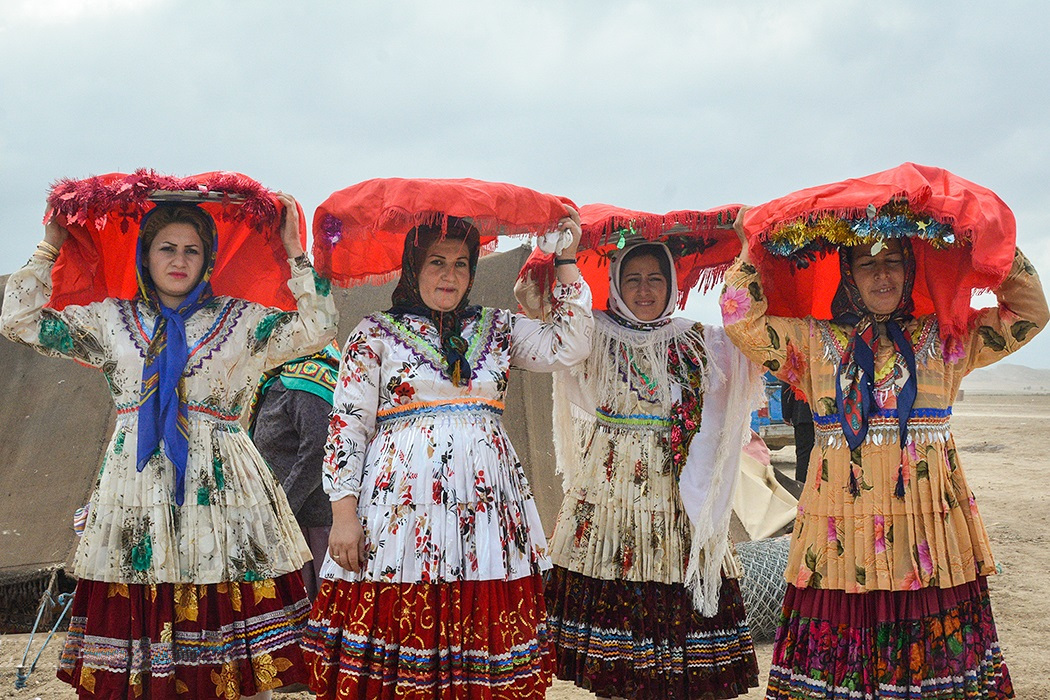
The Qashqai are a Turkic-speaking tribal confederation of the southern Zagros, centred on Fars province around Shiraz and Firuzabad. Unlike most of Iran's Turkic and tribal peoples on the borders, they live in the Persian heartland, and they speak their own Oghuz Turkic language, Qashqai, alongside Persian. Many still make the twice-yearly migration of several hundred kilometres between winter pastures near the Gulf lowlands and summer pastures in the high mountains, living in black goat-hair tents, though most are now settled in villages and towns. Qashqai women are known for their bright layered skirts and for weaving some of Iran's most celebrated tribal rugs, the thick gabbeh and the kilim.
Read more- Population
- 1,380,000
- Language
- Western Balochi
- Religion
- Islam - Sunni
- Location
- Northern Sistan and Baluchestan (Zahedan, Khash, Mirjaveh, Saravan, Taftan); Baloch clans in Razavi and South Khorasan, Golestan and eastern Kerman
The Western Baloch are the Baloch of the Sarhad, the high, arid borderland around Zahedan, Khash, Mirjaveh and Saravan in northern Sistan and Baluchestan, together with the Baloch clans that Nader Shah and later rulers settled in Khorasan, Golestan and eastern Kerman. They speak the Rakhshani (Sarhaddi) dialects of Balochi, an Iranian language distinct from Persian, and are overwhelmingly Sunni Muslims of the Hanafi school in a state whose official religion is Twelver Shia Islam. Society is organised in tribes such as the Rigi, Shahbakhsh, Ismailzahi, Gamshadzahi and Yarahmadzahi, whose sardars and Sunni clerics, above all the Friday prayer leader of Zahedan's Makki Mosque, carry more weight locally than state officials. Baloch women's needlework (suzan-dozi), with dense geometric motifs on dress panels and cuffs, is the region's best-known craft. The Sarhad is Iran's poorest region, and many families live from cross-border fuel carrying, livestock and remittances under heavy security pressure.
Read more- Population
- ~1,200,000-1,500,000
- Language
- Northern Kurdish
- Religion
- Islam
- Location
- Northern West Azerbaijan (Urmia, Salmas, Khoy, Maku, Chaldoran) and North and Razavi Khorasan (Quchan, Shirvan, Bojnurd, Esfarayen, Dargaz, Mashhad)
Iran's Kurmanji Kurds live in two blocs more than 1,000 kilometres apart. In the west, Sunni tribes such as the Shikak, Herki, Jalali and Milan hold the mountains and valleys around Urmia, Salmas, Khoy and Maku along the Turkish border. In the northeast, Shia Kurds in North and Razavi Khorasan descend from frontier guards whom the Safavid shahs deported from Anatolia around 1600. Unlike the Sorani-speaking Kurds to their south, both blocs speak Northern Kurdish, the language of most Kurds in Türkiye and Syria. The Khorasani Kurds keep a culture of their own: bards singing to the two-stringed dotar, women's pleated velvet skirts in red, orange or yellow, and wrestling in thick woollen coats at Nowruz. In the western highlands, some families still move their flocks between winter villages and summer pastures in the border valleys.
Read more- Population
- 1,336,000
- Language
- Bakhtiari
- Religion
- Islam - Shia
- Location
- Chaharmahal and Bakhtiari (summer pastures: Shahr-e Kord, Farsan, Kuhrang, Ardal, Lordegan); eastern Khuzestan (winter pastures: Masjed Soleyman, Izeh, Lali, Andika, Bagh-e Malek); western Isfahan; southeastern Lorestan (Aligudarz)
The Bakhtiari are the largest Lur tribal confederation, about 1.3 million people of the central Zagros between Isfahan and the Khuzestan plain. Divided since medieval times into the Haft Lang and Chahar Lang moieties, they are the classic Iranian nomads: each spring and autumn families still drive flocks over passes above 3,000 m and across the Karun and Bazoft rivers between the lowland winter pastures and the summer pastures below Zard Kuh. Men wear the striped wool chugha cloak and round felt cap, and Bakhtiari women weave carpets with distinctive garden-panel designs. Bakhtiari khans helped win the Constitutional Revolution in 1909, and the first Middle Eastern oil was struck on their land at Masjed Soleyman in 1908. Most are now settled, and drought and the transfer of their rivers' water to Isfahan are central grievances.
Read more- Population
- ~1,000,000-1,500,000
- Language
- Turkmen
- Religion
- Islam - Sunni
- Location
- Turkmen Sahra in Golestan (Gonbad-e Kavus, Bandar Torkaman, Aq Qala, Gomishan, Kalaleh, Maraveh Tappeh) and northern North and Razavi Khorasan
Iran's Turkmen, roughly a million or more Sunni Muslims, live on the Turkmen Sahra, the steppe plain east of the Caspian Sea around Gonbad-e Kavus, Bandar Torkaman and Aq Qala, and along the Turkmenistan border in North Khorasan. Their Yomut and Goklen tribes were nomadic horsemen until the 20th century, and Iran's border cut them off from their kin in Turkmenistan. As Sunni Hanafi Muslims and speakers of Turkmen they are a double minority in the Shia Persian state. Horse racing on the Gonbad, Aq Qala and Bandar Torkaman tracks, red-dyed Turkmen carpets and the dutar songs of their bakhshis are at the heart of their culture.
Read more- Population
- 1,200,000
- Language
- Southern Balochi
- Religion
- Islam - Sunni
- Location
- Iranian Makran: southern Sistan and Baluchestan (Iranshahr, Chabahar, Konarak, Sarbaz, Rask, Nikshahr, Dashtiari, Bampur), eastern Hormozgan (Jask, Sirik) and southern Kerman (Qaleh Ganj, Rudbar-e Jonub, Kahnuj)
The Southern Baloch of Iran are the Makrani Baloch of the Gulf of Oman coast and the date-palm valleys behind it, from Chabahar, Konarak and Dashtiari in the south to Iranshahr, Bampur, Sarbaz and Nikshahr inland, with outliers in eastern Hormozgan and southern Kerman. They speak Southern (Makrani) Balochi, the same variety as their kin across the Pakistani border in Gwadar and Turbat, and are Sunni Muslims of the Hanafi school in Shia-ruled Iran. Coastal Baloch fishing communities, including the Med, sing the amba work songs as they haul nets from wooden boats, while inland families live from date groves, herding and the cross-border trade. Chabahar, Iran's only ocean port, is the focus of a state Makran coastal development plan that many Baloch see as a threat of land seizure and demographic change.
Read more- Population
- 1,100,000
- Language
- Southern Luri
- Religion
- Islam - Shia
- Location
- Kohgiluyeh and Boyer-Ahmad (Yasuj, Dehdasht, Dogonbadan); eastern Khuzestan (Behbahan area); western Bushehr (Deylam, Genaveh)
The Southern Lurs are the tribes of the southern Zagros around Mount Dena: the Boyer-Ahmad and the Kohgiluyeh tribes such as the Bahmai and Tayyebi. Numbering about 1.1 million, they speak Southern Luri, a close relative of Persian, and form the majority in Kohgiluyeh and Boyer-Ahmad province. Once transhumant herders moving between Dena's summer pastures and the warm lowlands toward the Gulf, most are now settled, but many families still migrate with their flocks, make spring butter and gather wild fruit in the oak forests. Men and women dance together at weddings in the handkerchief dance, unusual among Muslim peoples of the region, and tribal loyalties remain strong. The tribes rose against the Pahlavi state in 1962-63, and in January 2026 Yasuj, Dehdasht and Gachsaran saw mass arrests of protesters.
Read more- Population
- 600,000
- Language
- Khorasani Turkish
- Religion
- Islam - Shia
- Location
- North Khorasan (Bojnurd, Shirvan, Esfarayen, Faruj) and Razavi Khorasan (Quchan, Dargaz, Kalat, Sabzevar, Neyshabur)
The Khorasani Turks are Twelver Shia Turks of northeastern Iran, descendants of Seljuk-era Oghuz tribes and of Qizilbash clans the Safavids settled in Khorasan in the 1500s to hold the frontier against the Uzbeks. They speak Khorasani Turkic, a language of its own that sits between Azerbaijani and Turkmen, and number roughly 600,000 across the valleys of Bojnurd, Quchan, Shirvan and Dargaz. Unlike their Sunni Turkmen neighbours, they share the Shia faith of nearby Mashhad. Their bakhshis, bards who sing epics and love songs to the two-stringed dutar, are recognised by UNESCO as part of the heritage of humanity.
Read more- Population
- 500,000
- Language
- Talysh
- Religion
- Islam - Sunni (Shafi'i) and Shia
- Location
- Northwestern Gilan (Talesh, Rezvanshahr, Masal, Astara and Fuman counties, incl. Masuleh) and the adjoining highlands of Ardabil province (Namin and Anbaran)
The Talysh of Iran live in the forested Talysh mountains and coastal plain of northwestern Gilan, the southern half of a homeland that Russia and Persia split along the Astara river in 1813-1828. They speak Talysh, a Northwestern Iranian language related to Tati and Zaza, and number around half a million, far more than on the Azerbaijani side's official count. Unlike most of their neighbours they are religiously divided: northern and central Talysh around Hashtpar, Asalem and Lisar are largely Sunni Muslims of the Shafi'i school, many tied to Naqshbandi Sufism, while southern Talysh of Masal, Shanderman and Masuleh are Twelver Shia. Mountain villages still move cattle and sheep between lowland winter quarters and summer pastures, and old beliefs in Siyah Galesh, the black herdsman who guards the flocks, survive alongside Islam.
Read more- Population
- 340,000
- Language
- Dezfuli
- Religion
- Islam
- Location
- Dezful and Shushtar cities and surrounding villages, northern Khuzestan; communities in Ahvaz and Tehran
The Dezfulis and Shushtaris are the old urban people of Dezful and Shushtar, twin historic cities of northern Khuzestan, about 340,000 strong, who speak their own Southwestern Iranian dialect, Dezfuli-Shushtari, related to both Persian and Luri. Their cities are among Iran's oldest: Dezful takes its name from a Sasanian fortress-bridge, and Shushtar's ancient weirs and water mills are a UNESCO World Heritage Site. Dezful's brick old town hides shavadan, cool underground rooms cut beneath the houses as refuge from summer heat above 50 C, and its reed pens are prized by calligraphers across Iran. Devout Shia, they mark Ashura with banners up to 12 m tall, and Dezful's endurance of more than 160 Iraqi missile strikes in the 1980s war is central to local pride.
Read more- Population
- ~305,000 (uncertain)
- Language
- Arabic, Gulf
- Religion
- Islam - Sunni
- Location
- Coast and islands of Bushehr and Hormozgan: Kangan, Asaluyeh, Deylam, Gavbandi (Parsian), Bandar Moqam, Charak, Kish, Lavan, Bandar Lengeh, Kong
The Gulf Arabs of Iran are Sunni Arab fishing and seafaring communities strung along the north shore of the Persian Gulf, from about fifty Arabic-speaking villages in Bushehr province to the ports of Charak, Moqam and Lengeh and the islands of Kish and Lavan in Hormozgan. Arab tribes such as the Bani Tamim, Al Nasur, Al Haram and the Qawasim ruled these ports in the 18th and 19th centuries; most of their kin, the Huwala, moved to Dubai, Sharjah, Bahrain and Qatar by the 1930s, and the families who stayed see themselves as both Arab and Iranian. Their Shafi'i Sunni faith and Gulf Arabic speech set them apart from the Shia, Persian-speaking majority, and they keep close family ties with relatives across the water. On Kish, native Arab families still go from house to house after Eid prayers, and each host serves Arab dishes and sweets.
Read more- Population
- 300,000
- Language
- Dari
- Religion
- Islam - Shia
- Location
- Takab and Shahin Dezh and around Urmia (West Azerbaijan); Khodabandeh/Qeydar and Khorramdarreh (Zanjan); Qazvin; Baft-Sirjan uplands (Kerman)
The Afshars are an ancient Oghuz Turkic tribe whose warriors helped put the Safavid dynasty on the throne in 1501 and whose son Nader Shah ruled an empire from Delhi to the Caucasus in the 1730s and 1740s. Roughly 300,000 strong, they live in scattered tribal territories where the Safavids planted them as frontier guards: around Takab and Urmia in West Azerbaijan, in Zanjan's Khodabandeh and Qeydar country, and in the uplands of Kerman. Most are Twelver Shia villagers and townspeople now, but many still trace their clan lineages and some Kerman Afshars still migrate with their flocks. Afshar women's rugs and saddlebags, with bold medallions and boteh motifs, are prized by collectors worldwide.
Read more- Population
- 300,000
- Language
- Persian (Iran); Arabic, Kurdish and Turkish in Iraq, Jordan and Türkiye
- Religion
- Baha'i Faith
- Location
- Nationwide and mainly urban: Tehran, Shiraz, Isfahan, Karaj, Yazd, Mashhad, Mazandaran, Semnan, Kerman, Tabriz
Iran is the birthplace of the Baha'i Faith, and its roughly 300,000 Baha'is are the country's largest non-Muslim religious minority, mostly Persian-speaking descendants of 19th-century converts from Muslim, Jewish and Zoroastrian families. Unlike Christians, Jews and Zoroastrians, they have no legal recognition: the state calls them a misguided sect, has executed more than 200 of their members since 1979, dissolved their elected assemblies and bars them from universities and public jobs. They keep their faith alive in private homes, with Nineteen-Day Feasts, children's classes and an underground volunteer university, while their cemeteries are bulldozed and their shops sealed. Arrests surged after the 2025 and 2026 wars, with Baha'is accused of spying for Israel because their world centre lies in Haifa.
Read more- Population
- 261,000
- Language
- Aimaq
- Religion
- Islam
- Location
- Razavi Khorasan along the Afghan border: Torbat-e Jam, Taybad and Bakharz, Khaf, Fariman and Mashhad; mainly the Timuri (Taimuri) tribe, with Jamshidi and other Aimaq groups and Afghan Aimaq refugees
The Aimaq of Iran are mainly the Timuri, a semi-nomadic Persian-speaking tribe whose ancestors moved from western Afghanistan's Badghis and Herat into Iranian Khorasan in the 18th and 19th centuries, joined by smaller groups of Jamshidi and other Aimaq. They live in the border districts of Torbat-e Jam, Taybad, Bakharz and Khaf and around Mashhad, where they speak an Aimaq dialect of Persian close to the Dari of Herat. Unlike the Shia Persian majority of Khorasan most are Sunni Muslims, which links them to the Sunni Afghans and Baloch of the borderland. Timuri women are renowned weavers of the rugs sold in the west as 'Herat Baluch' and Timuri carpets, and herding families still move their flocks seasonally across the Khorasan steppe. Their numbers are swelled by Aimaq refugees from Afghanistan, many of whom were deported in 2025.
Read more- Population
- 250,000
- Language
- Iranian Sign Language
- Religion
- Unknown
- Location
- Nationwide; Deaf schools, associations and sports clubs in every provincial capital, largest in Tehran, Mashhad, Isfahan, Karaj, Shiraz and Tabriz
Iran's Deaf community, about a quarter of a million people, shares Iranian Sign Language, a language that grew up in the country's own deaf schools after Jabbar Baghcheban opened the first one in Tabriz in 1924 and that is unrelated to the Arab sign languages next door. Deaf Iranians come from Persian, Azerbaijani, Kurdish, Lur, Baloch and Arab families alike, and frequent marriage between cousins makes hereditary deafness common, so many have Deaf brothers, sisters or parents. Schools still teach mostly by speech and favour cochlear implants, so most learn to sign from one another, in Deaf associations and clubs and on the futsal courts where Iran's Deaf teams have become world champions. Sermons, Quran recitation and Muharram preaching are almost never interpreted, and the only Christian resource in their language is the JESUS film.
Read more- Population
- ~200,000-280,000 (tribal population)
- Language
- Khamseh Arabic
- Religion
- Shia Islam (Twelver)
- Location
- Eastern and south-eastern Fars (Sarvestan, Fasa, Darab, Neyriz, Kharameh, Jahrom, Larestan; summer pastures in Bavanat, Khorrambid, Sarchahan); northern Hormozgan
The Khamseh Arabs are Arabic-speaking tribes of eastern Fars, the Jabbareh and the Sheybani, whose ancestors came from Arabia in the early Islamic centuries and who form the Arab branch of the Khamseh confederation. Their Arabic dialect, laced with Persian, Turkish and Luri words, is so different from the Arabic of Khuzestan and the Gulf that other Arabs struggle to understand it, and unlike the Gulf-coast Arabs they are Shia. For generations they migrated with their flocks between the uplands of Bavanat and the warm plains of Fasa, Darab and Larestan, living in black goat-hair tents; most are now settled. Arab women weave about two in five of all hand-knotted carpets made in Fars.
Read more- Population
- ~160,000-300,000
- Language
- Luri, Southern
- Religion
- Islam
- Location
- Mamasani County (Nurabad, Fahliyan) and Rostam County (Masiri) in northwestern Fars, with sections in Sepidan and Kuhchenar counties and in Kohgiluyeh and Boyer-Ahmad; migrants in Shiraz
The Mamasani are a confederation of Lur tribes who, late in the Safavid era, came down from Kohgiluyeh and conquered Shulestan, the green valleys between the southern Zagros and Shiraz, which has carried their name ever since. Their four great sections, the Rostam, Bakesh, Javidi and Doshmanziari, were feared musketeers and rebels who resisted Zand, Qajar and Pahlavi rulers and joined the southern tribal revolt of 1962-63. They speak the Mamasani dialect of Southern Luri and are Shia Muslims, living today in the towns of Nurabad and Masiri and in hundreds of villages among rice fields, orchards and oak-forested ridges, while some families still migrate with their flocks. At weddings women dance the handkerchief dance to the saz and naqareh, and women's skirts are cut from five to twelve metres of brightly coloured cloth.
Read more- Population
- ~100,000-300,000
- Language
- Turkish
- Religion
- Islam - Shia
- Location
- Ardabil Province (Meshginshahr, Ardabil, Moghan plain, Mount Sabalan); scattered branches in Zanjan, Qazvin, Saveh and Varamin
The Shahsevan are a confederation of Azerbaijani-speaking Shia Turkic tribes of Iran's far northwest, said to have been founded as loyal servants of the Safavid shahs, which is what their name, "those who love the shah", means. Tens of thousands of them still live as pastoral nomads, moving their flocks and dome-shaped felt tents (alachiq) between the low Moghan steppe on the Aras River in winter and the high pastures of Mount Sabalan in summer, a round trip of some 400 km. Their women weave kilims, sumak bags and verni flatweaves prized by collectors. Most people of Shahsevan descent have settled in villages and towns and now see themselves simply as Azerbaijani Turks, while drought and rising costs are pushing more herding families to give up the migration.
Read more- Population
- 200,000
- Language
- Takestani
- Religion
- Islam - Shia
- Location
- Takestan County (Takestan, Esfarvarin, Khoznin) and Ramand district of Buin Zahra County (Danesfahan, Khiaraj, Ebrahimabad, Sagezabad, Chal), Qazvin province; migrants in Qazvin, Karaj and Tehran
The Takestani Tats live in the vineyard town of Takestan and the villages of the Ramand plain south of Qazvin, the largest surviving community of the Tati language group that once covered Iran's northwest. Their city, which they call Siayden, is said to be the largest Tat town in the world, and its 35,000 hectares of vines make it one of Iran's main sources of raisins. They speak Takestani, a Southern Tati language related to Talysh and Zaza, alongside Persian and often Azerbaijani, and they hold to a strong sense of being a distinct people with a 3,000-year history. They are Twelver Shia Muslims, and no Scripture or church exists in their own language.
Read more- Population
- ~150,000-235,000
- Language
- Gurani
- Religion
- Islam - Shia
- Location
- Hawraman (Uramanat) on the Iraqi border: Paveh, Nowsud and Nodsheh (Hawraman-e Lahun, Kermanshah); Uraman Takht and Sarvabad (Hawraman-e Takht, Kurdistan); Palangan and the Zhawarud valley (Kamyaran); migrants in Kermanshah city; Gurani-speaking Yarsan villages near Gahvareh and at Zarda (Dalahu)
The Hawrami are the mountain people of Hawraman, a deep valley country on the Iran-Iraq border whose stepped villages, built so that one family's roof is the next family's yard, were inscribed by UNESCO as a World Heritage cultural landscape in 2021. They speak Hawrami, the oldest-sounding form of Gorani, a Northwestern Iranian language that still marks masculine and feminine and stands apart from the Kurdish spoken around them; it was the court poetry language of the Ardalan princes, and its sister dialect Gurani, kept by a few Yarsan villages near Gahvareh, is the sacred language of Yarsan hymns. Almost all Hawrami in Iran are Sunni Muslims of the Shafi'i school with deep Naqshbandi and Qadiri Sufi roots, centred on Paveh, Nowsud and Uraman Takht. Every winter Uraman Takht celebrates the wedding of Pir Shalyar, a legendary healer, with walnuts carried from house to house, communal sacrifices and circle dances to the daf. Unemployment and water shortages are emptying many villages, and young people increasingly speak Persian and Sorani Kurdish.
Read more- Population
- 127,000
- Language
- Lari
- Religion
- Islam (Sunni and Shia)
- Location
- Larestan: southern Fars (Lar, Gerash, Evaz, Khonj, Lamerd, Mohr, Juyom) and western Hormozgan (Bastak, Bandar Lengeh, Kukherd); migrants in Shiraz
The Achomi, also called Larestanis or Khodmooni, are the people of Larestan, the sun-baked uplands between Shiraz and the Persian Gulf, and speak Achomi, a direct descendant of Middle Persian that other Iranians cannot understand. They are the only large Persian-speaking community in Iran that is split between Sunni and Shia Islam: towns like Evaz, Khonj and Bastak are Shafi'i Sunni, while Gerash and most of Lar are Twelver Shia. For generations Achomi traders have crossed the Gulf, and Dubai's old Al Bastakiya quarter, with its wind towers, is named after migrants from Bastak. Their towns are built around great domed rainwater cisterns, and their tables share Gulf dishes such as mahyawa fish sauce and ranginak date sweets.
Read more
- Population
- 119,000
- Language
- Southwestern Fars
- Religion
- Islam - Shia
- Location
- Rural central and western Fars: Kuhmareh districts (Kuhchenar County), Davan and Masarm near Kazerun, Papun, Buringun, Khollar and Ardakan (Sepidan), Kondazi (Marvdasht)
The southwestern Fars dialect speakers are Persian villagers of the Zagros foothills between Shiraz and Kazerun whose everyday speech is not standard Persian but its sister: a chain of village dialects descended directly from Middle Persian, which their speakers long called Tajiki. Each district has its own variety, from Kuhmareyi in the Kuhmareh valleys to Davani, spoken by about a thousand people of Davan village north of Kazerun. They farm grain and orchards and herd flocks, and Khollar was once one of Iran's famed wine villages. They are Twelver Shia, and their dialects are fading as young people move to Shiraz.
Read more- Population
- ~50,000-100,000
- Language
- Georgian
- Religion
- Islam - Shia (Twelver)
- Location
- Fereydunshahr and surrounding villages of Fereydan (western Isfahan province); descendants in Isfahan, Najafabad, Tehran and Karaj
The Fereydani Georgians descend from Georgians whom Shah Abbas I deported from Kakheti and Kartli in the 1610s and settled in the high Fereydan basin west of Isfahan, where they gave their villages Georgian names and guarded the road to the Safavid capital. Unlike almost all other Georgians, they are Twelver Shia Muslims, converted under the Safavids, yet in Fereydunshahr and its villages most people still speak a 400-year-old Kakhetian dialect of Georgian alongside Persian. Fereydunshahr, at about 2,500 metres the highest town in Iran, has Georgian lettering on its shop signs, and local ensembles still sing Fereydani Georgian songs. Perhaps 50,000 to 100,000 Iranians are of Georgian descent, though outside Fereydan most now speak only Persian.
Read more- Population
- ~40,000-70,000
- Language
- Armenian
- Religion
- Christianity - Armenian Apostolic
- Location
- Tehran (about three-quarters), Isfahan's New Julfa, Tabriz, Urmia, Fereydan (Peria) villages; small parishes in Arak, Shiraz, Rasht and Ahvaz
Armenians are Iran's oldest and largest Christian community, native to the country's northwest for millennia and reshaped in 1604-05 when Shah Abbas I resettled Armenians from Julfa on the Aras River in New Julfa, a purpose-built quarter of Isfahan. Today roughly 40,000 to 70,000 remain, about three-quarters of them in Tehran, down from 200,000 or more before 1979 as families have left for the United States and Armenia. They speak a distinctive Iranian dialect of Eastern Armenian, run their own schools, sports clubs and the daily newspaper Alik, and hold two reserved seats in parliament. The Armenian Apostolic Church may worship freely in Armenian but may not hold services in Persian or receive Muslim converts. Each July thousands of pilgrims gather at the black-stone Monastery of Saint Thaddeus near the Turkish border, the largest Christian gathering in the country.
Read more- Population
- 55,000
- Language
- Semnani
- Religion
- Islam - Shia
- Location
- Semnan city and its western suburbs (Zavoqan, Koshmaqan, Kodiyur), Semnan province; Biyabanaki villages near Dehnamak
The Semnanis are the native people of Semnan, an oasis city at the foot of the Alborz mountains on the edge of the Great Salt Desert, 216 km east of Tehran. They speak Semnani, an ancient Northwestern Iranian language with grammatical gender that is unintelligible to Persian speakers and closer to Zazaki in distant Anatolia than to any neighbouring tongue. About 55,000 people still speak it, mostly at home and among older people, while many more of the roughly 300,000 people of Semnani descent now speak only Persian. For a thousand years the city has divided Alborz snowmelt among its seven historic quarters through stone channels and stepped ponds. Semnanis are Twelver Shia, and Semnan's Sufi heritage goes back to the medieval master Ala al-Dawla Simnani.
Read more- Population
- 52,000
- Language
- Khalaj
- Religion
- Islam - Shia
- Location
- Khalajestan: villages between Qom, Tafresh and Ashtian (Qom and Markazi provinces)
The Khalaj are a small Shia people of the dry uplands between Qom and Tafresh whose language is the last living member of its own branch of the Turkic family, a descendant of the medieval Arghu tongue that keeps sounds lost in every other Turkic language. Their ancestors came from the Ghazni region of Afghanistan, where other Khalaj founded the Khalji sultanate of Delhi, and settled near Saveh in the Seljuk era. Some 50,000 people of Khalaj descent live in the villages of Khalajestan, but most now speak Persian and only about 19,000 still speak Khalaj, with very few children learning it. Villages such as Talkhab still sing Muharram laments and recite proverbs in the old language.
Read more- Population
- ~40,000-60,000
- Language
- Kurdish, Northern
- Religion
- Islam
- Location
- Sumay-Beradust District of Urmia County and Kuhsar District (Chahriq, Shepiran) of Salmas County, West Azerbaijan; migrants in Urmia and Salmas
The Shikak are a Kurmanji-speaking Sunni Kurdish tribe holding the mountains west of Lake Urmia between Urmia and Salmas, where their Awdoi clan settled from Diyarbakır in the 17th century. Their chief Ismail Agha, known as Simko, made the tribe famous: from 1918 to 1922 he ruled the lands west of Lake Urmia with an army of 20,000 to 30,000 Kurds, killed the Assyrian patriarch Mar Shimun, and fought the Qajar and Pahlavi armies until he was lured to Oshnavieh and killed in 1930. That history still colours relations between Kurds, Azerbaijanis and Assyrians around Urmia and Salmas. Once nomadic herders, the Shikak are now settled in the villages of Sumay and Chahriq and in the poor western suburbs of Urmia, where tribal loyalty, led by Simko's descendants, has survived better than among other Kurdish tribes.
Read more- Population
- 40,000
- Language
- Sangisari
- Religion
- Islam - Shia
- Location
- Mahdishahr (Sangesar) and nearby Darjazin and Talebabad, Mahdishahr County, Semnan province; seasonal pastures in the Alborz (Firuzkuh, Damavand) and the Kavir edge; migrants in Tehran
The Sangisaris are the people of Sangesar, a mountain town just north of Semnan that was renamed Mahdishahr after 1979, and of the herding tribe that takes its name from it. Their language, Sangisari, is an ancient Northwestern Iranian tongue with grammatical gender on verbs, related to Zazaki in Anatolia and unintelligible to Persian speakers. Sangsari shepherds make one of the longest seasonal migrations in the world, up to 1,500 km a year between the desert edge and the Alborz pastures. They live in black goat-hair tents called goot, make more than 30 kinds of dairy products and keep their own ancient pastoral calendar. Most are Twelver Shia, but Sangesar was among the first Babi and Baha'i strongholds in Iran, and its Baha'is have faced repeated persecution.
Read more- Population
- ~35,000-40,000
- Language
- Bashkardi
- Religion
- Islam - Shia
- Location
- Bashagard County, eastern Hormozgan (Sardasht, Gowharan, Gafr and Parmon); related speech in southern Kerman (Rameshk) and at Garu near Minab
The Bashkardis are the people of Bashagard, a remote knot of dry mountains in eastern Hormozgan, and speak Bashkardi, an endangered Southwestern Iranian language with northern and southern forms so different that their speakers may not understand each other. Unlike most of Iran's southeast, they are mainly Twelver Shia, and after the 1979 revolution their poverty made Bashagard a symbol of the state's rural development drive. Families of Iranian, African and South Asian descent live side by side in stone and palm-frond villages, growing dates and sharp-scented garlic and gathering wild honey and mushrooms. Their oral tradition is rich in trickster tales and formal greetings shared with neighbouring Baluchistan.
Read more- Population
- ~20,000-40,000
- Language
- Shahrudi
- Religion
- Islam - Shia
- Location
- Shahrud district of Khalkhal county, Ardabil province (Kolur, Shal, Lerd, Asbu, Derav, Karnaq, Gilavan); migrants in Tehran, Karaj and Qods
The Central Tats live in the high Alborz valleys of Shahrud district in southern Khalkhal, Ardabil province, in villages such as Kolur, Shal, Lerd and Asbu, surrounded by an Azerbaijani-speaking majority. Their language, Shahrudi, is an ancient Northwestern Iranian tongue so close to Southern Talysh that linguists group them together, and it is now fading among the young. For generations their men left each year to plant rice in Gilan or to fell timber in the Caspian forests, and the woodcutters of Lerd and Karnaq even created a secret Tati-based trade language. Lerd's women still sew the traditional sheh shelwar dress, and belief in sacred groves and in Al, the red spirit who threatens newborns, lives on beside Shia Islam.
Read more- Population
- 29,000
- Language
- Ashtiani
- Religion
- Islam - Shia
- Location
- Ashtian city and County, Markazi province, with related villages in Tafresh County; emigrants in Tehran, Qom and Arak
The Ashtianis are the people of Ashtian, an upland town and county between Arak and Qom whose old speech is a Tati-type Northwestern Iranian dialect, a close sister of Vafsi, now giving way to Persian. This small, shrinking community has had an outsized place in Iranian history: the Mostowfian Ashtiani family were hereditary accountants and prime ministers of the Qajar state, and Prime Minister Mohammad Mosaddegh's paternal family came from here. Ashtian is known for its carpets, qanat-watered fields and Safavid caravanserai. Ashtianis are Twelver Shia and think of themselves as Persians.
Read more- Population
- ~20,000-35,000
- Language
- Assyrian Neo-Aramaic
- Religion
- Christianity - Church of the East
- Location
- Tehran (majority); Urmia and the Assyrian villages of the Urmia plain, Targawar and Salmas (West Azerbaijan); small parishes in Kermanshah, Hamadan, Qazvin, Shahin Shahr and Ahvaz
Assyrians are an Aramaic-speaking Christian people who have lived on the western shore of Lake Urmia since antiquity, making them one of Iran's oldest communities and its second-largest Christian minority after the Armenians. Their Urmia dialect of Neo-Aramaic became, through a 19th-century American mission press, the standard literary language of Assyrians worldwide, and Urmia's Mart Maryam church is revered as one of the oldest churches in the world. Massacres in 1914-1918 and emigration after 1979 shrank a community of well over 100,000 to perhaps 20,000 to 35,000, most of them now in Tehran. Most belong to the Assyrian Church of the East, with Chaldean Catholic, Presbyterian and Pentecostal minorities, and they hold one reserved seat in parliament shared with the Chaldeans. Every 1 April families mark Kha b-Nisan, the Assyrian New Year, with line dances to drum and shawm.
Read more- Population
- 25,000
- Language
- Jadgali
- Religion
- Islam - Sunni
- Location
- Dashtiari county (Negur, Bahu Kalat, Pullan, Pir Sohrab area) and Chabahar in southern Sistan and Baluchestan; smaller groups in eastern Hormozgan and southern Kerman
The Jadgal are an Indo-Aryan people of the far south-eastern corner of Iran, living in the Dashtiari plain between Chabahar and the Pakistani border, where they speak Jadgali, a language of the Sindhi family closely related to Lasi. Their ancestors came from Sindh by way of Las Bela and Makran centuries ago; they call themselves Nummar, and Jadgal is the Balochi name for them. Surrounded by Baloch, the men speak Balochi with outsiders and the community is generally counted as Baloch, yet Jadgali remains the home language and the Jadgal keep a separate identity, with leading families such as the Sardarzahi. They are Sunni Muslims who farm dates and bananas along the Sarbaz and Bahu rivers, a flood-prone landscape that is also home to Iran's last mugger crocodiles, the gando.
Read more- Population
- 24,000
- Language
- Brahui
- Religion
- Islam - Sunni
- Location
- Sistan and Baluchestan (Khash, Saravan and the Zahedan-Sistan border area); a village community at Tom-Meyri, Rudbar-e Jonub county, Kerman
The Brahui of Iran are a small, scattered branch of the Brahui people of Pakistani Balochistan, living among the Baloch around Khash, Saravan and the Sistan border, with one village community at Tom-Meyri in Rudbar-e Jonub in southern Kerman. Their ancestral language, Brahui, is Dravidian, related to languages of central and southern India and an island among Iran's Iranian and Turkic languages. In Iran most Brahui families now speak Balochi at home and Persian outside, and see themselves as a tribe within the Baloch nation; the Tom-Meyri community of about 750 people is one of the few that still uses Brahui daily and is being documented as an endangered language. Like the Baloch around them, they are Sunni Muslims of the Hanafi school.
Read more- Population
- 24,000
- Language
- Kurdish, Northern
- Religion
- Islam
- Location
- Highland districts west and southwest of Urmia (Margavar, Targavar, Dasht) and Dasht-e Bil near Oshnavieh, West Azerbaijan; migrants in western Urmia
The Herki are a Kurmanji-speaking Sunni Kurdish tribe whose lands straddle the mountain border where Iran, Iraq and Türkiye meet. In Iran they hold the green border valleys of Margavar and Targavar west of Urmia and the plain of Dasht-e Bil near Oshnavieh, where they once arrived each summer with their flocks from winter grounds in Iraq. For centuries they were among the last great migratory tribes of Kurdistan, known as herders, weavers of fine rugs and caravan carriers between countries. Most are now settled villagers or city dwellers in Urmia, but many families still move their sheep between valley villages and high summer pastures, and the Herki costume is still worn as a badge of Kurdish identity. Their three branches, the Mendan, Sidan and Serhati, trace their descent to legendary ancestors.
Read more- Population
- 24,000
- Language
- Neo-Mandaic
- Religion
- Mandaeism
- Location
- Khuzestan: Ahvaz (main), Khorramshahr, Abadan, Shushtar, Dezful, Hoveyzeh, Shadegan; also Tehran and Karaj
Iran's Mandaeans are a tiny Aramaic-heritage people of Khuzestan, followers of the world's last surviving Gnostic religion, who revere John the Baptist and baptise themselves again and again in flowing river water. Perhaps 2,000 to 10,000 remain, most in Ahvaz, where white-robed worshippers still wade into the Karun on Sundays despite its pollution, and where Mandaean goldsmiths have worked for generations. Unlike Christians, Jews and Zoroastrians, they are not a recognised minority, so they cannot register their children's religious names, struggle to enter university and are shut out of public jobs and the food trade. War with Iraq in the 1980s scattered the community, and emigration to Australia, Sweden and the United States has left more Iranian Mandaeans abroad than at home.
Read more- Population
- 20,000
- Language
- Khunsari
- Religion
- Islam - Shia
- Location
- Khansar town and county, western Isfahan province; Vanishan (Golpayegan County); migrants in Tehran, Qom and Isfahan
The Khunsaris are the people of Khansar, a long valley town at 2,250 m in the Zagros of western Isfahan province, watered by hundreds of springs. They speak Khunsari, one of the ancient 'Median' dialects of the central plateau, which survives in parts of the town after the surrounding villages switched to Persian. Khansar's orchards, honey and gaz nougat are famous, and every spring the slopes of Golestan Kuh above the town turn red with wild tulips and crown imperial lilies. The town is a stronghold of Twelver Shia scholarship that has produced leading ayatollahs and many of Tehran's publishers, and its Jewish quarter, which once had two synagogues, is now gone.
Read more- Population
- ~15,000-23,000
- Language
- Iranian Persian
- Religion
- Zoroastrianism
- Location
- Tehran, Yazd city and villages (Taft, Mazra-ye Kalantar, Sharifabad), Kerman, Karaj, Isfahan, Shiraz
Iran's Zoroastrians are the last native community of the faith that was the religion of the Persian empires before Islam, about 23,000 people at the 2016 census and fewer since, through steady emigration to the United States. For centuries they survived in the desert cities of Yazd and Kerman, where some elders still speak their own language, Zoroastrian Dari, and where a sacred fire in the Yazd fire temple has been kept burning, by tradition, for some fifteen hundred years. Today most live in Tehran as highly educated professionals, recognised by the constitution and holding one seat in parliament, yet barred from senior posts and squeezed by intermarriage, a falling birth rate and a shortage of priests. Their midwinter Sadeh bonfire and the June pilgrimage to the mountain shrine of Chak Chak draw crowds far beyond the community.
Read more- Population
- ~11,000-20,000
- Language
- Azerbaijani, South
- Religion
- Islam
- Location
- Darab, Fasa, Marvdasht, Zarqan, Arsanjan and Kazerun in Fars; smaller branches in Chaharmahal and Bakhtiari, Isfahan, Hamadan, Kurdistan, Kerman and Khorasan
The Baharlu are a Turkic tribe of Fars who trace their descent to the Qara Qoyunlu, the Black Sheep Turkmen dynasty of the 15th century, and count the Mughal regent Bairam Khan among their forebears. One of the five tribes of the Khamseh confederation, they settled along the Darab river a century ago after generations of seasonal migration, and they speak a Turkish dialect that sets them apart from both their Persian neighbours and the larger Qashqai. Baharlu women weave some of the finest tribal rugs in Fars, crowded with birds and pomegranate trees, and Baharlu weavers make more all-bird carpets than any other tribe of the province.
Read more- Population
- ~10,000-15,000
- Language
- Iranian Persian
- Religion
- Islam - Shia
- Location
- Bandar Abbas (eastern suburbs) and the villages toward Minab, Hormozgan; southern Fars (Galehdar and Chah Shurak in Mohr, Lar, Lamerd, Khonj, Jahrom, Fasa, Firuzabad, Qir va Karzin); Shiraz suburbs, Marvdasht and Kazerun in northwestern Fars
The Korosh are a tribe of Baloch origin, well over 10,000 people, scattered from Bandar Abbas on the Gulf through southern Fars to the outskirts of Shiraz. Their ancestors came west from Iranian Balochistan along the Makran coast, and their language, Koroshi, is a form of Balochi that is still spoken by young and old in the villages between Bandar Abbas and Minab where they are the majority, while in Fars it is giving way to Persian and Qashqai Turkic. Unlike the Sunni Baloch, they are Shia, and many in Fars belong to the Qashqai confederation, for whom they long served as camel herders on the great seasonal migrations. Northern herders still play the kalam flute used to drive camels, the same instrument as the Baloch nal, while southern Korosh women wear the black chador and the Bandari face mask of the Gulf coast.
Read more- Population
- 11,000
- Language
- Judeo-Persian
- Religion
- Judaism
- Location
- Tehran (majority), Isfahan, Shiraz; small remnants in Hamadan, Kermanshah, Yazd and Kashan
Persian Jews have lived in Iran for some 2,700 years, since before Cyrus the Great freed the exiles of Babylon, and the tombs of Esther and Mordecai in Hamadan still draw pilgrims. Once about 100,000 strong, the community has shrunk to roughly 9,000 to 15,000 people, mostly in Tehran, with smaller congregations in Isfahan and Shiraz, after most families left for Israel and Los Angeles following the 1979 revolution. Jews are a recognised minority with a seat in parliament, their own schools, kosher shops and a charity hospital, and they speak Persian with old Judeo-Persian dialects surviving among elders. Their position is precarious: the state suspects them of ties to Israel, dozens were arrested after the June 2025 war, and a Tehran synagogue was wrecked in the 2026 air strikes. This presence also counts the community IMB lists separately as 'Jew, Judeo-Persian' (PEID 24199, ROP3 102808), whose Iran presence is excluded as counted here.
Read more- Population
- ~10,000-12,000 (fewer active speakers)
- Language
- Sorkhei
- Religion
- Islam
- Location
- Sorkheh town and Aftar (Hafdar) village, Sorkheh County, Semnan province, with migrants in Semnan, Tehran and Mazandaran towns
The Sorkhei are the native people of Sorkheh, a small town of about 10,000 on the edge of the great salt desert west of Semnan, and of Aftar, a herding village high in the Alborz to its northwest. Their ancestral speech, Sorkhei, is one of the Komisenian languages, a cluster of ancient Iranian tongues that survive as islands in a Persian-speaking sea around Semnan, and it is closer to the speech of neighbouring Lasjerd than to Persian. Sorkhei is so little known outside the town that soldiers from Sorkheh used it as a radio code during the Iran-Iraq War, and Sorkheh-born president Hassan Rouhani has said his brother relayed messages to him in it during the nuclear talks. Ashura is the great event of the year, when drum processions and a burning-tent ceremony fill the town's mourning hall. Today most townspeople also speak Persian, and Sorkhei survives mainly among older people and at home, while Aftar's speech is fading as its families move to the cities.
Read more- Population
- 10,000
- Language
- Nayini
- Religion
- Islam
- Location
- Nain town and nearby villages (Mohammadiyeh, Bafran, Benvid), Anarak, and the Tudeshk-Mashkenan area, Isfahan province
The Nayinis are the people of Nain, an ancient mud-brick town on the western edge of Iran's Great Salt Desert, and of nearby oases such as Anarak. They speak Nayini, one of the old 'Median' dialects of the central plateau and a close cousin of the Dari spoken by the Zoroastrians of Yazd, so different from Persian that, as locals joke, outsiders cannot tell whether two Nayinis are arguing or reciting poetry. Nain's 10th-century mosque is one of the oldest in Iran, its Sasanian citadel still towers over the old town, and its name is known worldwide for fine wool-and-silk carpets. Nayinis are Twelver Shia Muslims, and their dialect is now spoken mainly by older people as the young shift to Persian.
Read more- Population
- ~6,000-10,000
- Language
- Iranian Persian
- Religion
- Islam - Shia
- Location
- Gaz-e Borkhar, 18 km north of Isfahan city, Shahin Shahr and Meymeh County, Isfahan province
The Gazis are the native people of Gaz, an ancient town on the plain north of Isfahan, and speak Gazi, one of the Central Plateau languages descended from the Median speech of pre-Islamic central Iran. Their language is a close sister of the speech once used by Isfahan's Jews, and it was entered in Iran's national heritage list in 2009, though younger Gazis now mostly speak Persian. The town's Seljuk-era Friday mosque is said locally to stand on the site of an ancient fire temple, and the national poet Adib Boroumand was born here. Gazis are Twelver Shia, and today their town is better known for making a fifth of Iran's bricks.
Read more- Population
- 7,000
- Language
- Natanzi
- Religion
- Islam
- Location
- Natanz County, Isfahan province: Badrud and its hamlets, Barzrud valley (Hanjan, Yarand, Abyaneh, Tara), Bidhand, Farizand, and the old quarter of Natanz
The Natanzis are the people of Natanz and the Karkas mountain villages between Kashan and Isfahan who still speak Natanzic, one of the ancient 'Median' dialects of the central plateau. In Natanz town only a few elderly people still speak the old dialect, but it survives in Badrud on the desert edge and in mountain villages such as Abyaneh, Hanjan and Yarand. Abyaneh is famous for its red-clay houses and its women's long pleated skirts and flowered headscarves. It also keeps traces of a late conversion from Zoroastrianism, such as offerings of food for the dead and a Sasanian fire temple in the middle of the village. The Natanzis are Twelver Shia, and their orchards of pears and pomegranates lie close to Iran's main uranium-enrichment site, which was bombed in 2025 and 2026.
Read more- Population
- 7,000
- Language
- Sivandi
- Religion
- Islam - Shia
- Location
- Sivand village, Polvar valley, Marvdasht County, Fars (on the Shiraz-Isfahan road between Persepolis and Pasargadae); migrants in Shiraz and Marvdasht
The Sivandis are the people of Sivand, a single large village in the Polvar valley of Fars between the ruins of Pasargadae and Persepolis, numbering perhaps 7,000 with those who have moved to nearby cities. Their language, Sivandi, is a Northwestern Iranian tongue akin to the dialects of the central plateau, an island entirely surrounded by Persian speech, and how it came to the heart of ancient Persis is a mystery. Once herders and caravan muleteers, many Sivandi men now work as truck drivers, while villagers tend orchards along the river. On the eve of the Chaharshanbe Suri fire festival before Nowruz, the village keeps its own ancient tek-tekak rite. Emigration, intermarriage and Persian schooling have cut the number of fluent speakers to a few thousand, and the community now teaches the language through its own online lessons.
Read more- Population
- 6,000
- Language
- Shahmirzadi
- Religion
- Islam - Shia
- Location
- Shahmirzad town, Shahmirzad District, Mehdishahr County, Semnan province (southern Alborz)
The Shahmirzadis are the native people of Shahmirzad, an orchard town 1,900 m up on the southern slopes of the Alborz, north of Semnan. Unlike their Semnani and Sangisari neighbours, they speak a Caspian language close to Mazandarani, a legacy of centuries when the town belonged to Tabaristan and families spent winters on the Caspian coast. Their walnut grove of about 700 hectares is said to be the largest in the world, and the town is a summer resort that grows from 11,000 to about 40,000 people in the warm months. Most Shahmirzadis today are Twelver Shia, but the town was one of the earliest Babi and Baha'i centres in Iran, and it also had a Jewish community that has since emigrated.
Read more- Population
- 5,000
- Language
- Arabic, Uzbeki
- Religion
- Islam - Shia (majority)
- Location
- Arabkhaneh villages, Nehbandan County, South Khorasan; Persianised families in Birjand, Mashhad, Nishapur
The Khorasani Arabs of eastern Iran descend from Arab tribes who settled in Khorasan after the Islamic conquest some thirteen centuries ago. Most of their roughly 50,000 descendants in Birjand, Mashhad and Nishapur now speak only Persian, but in the Arabkhaneh ('house of the Arabs') villages of Nehbandan County, about 100 km south of Birjand, a few thousand people still speak an ancient Arabic that locals call Badawi Arabic. Linguists found its closest relatives not in Iraq or Arabia but in the Arabic-speaking villages of Afghanistan and Uzbekistan. Drought has emptied many of these desert-edge villages, and a community Telegram channel now teaches the dialect to the young one word at a time.
Read more- Population
- ~2,000-5,000
- Language
- Karingani
- Religion
- Islam - Shia
- Location
- Galin Qayah (Harzandat-e Gharbi rural district) and the Babereh (Babertin) villages of Harzandat-e Sharqi, Marand County, East Azerbaijan, with migrant families in Marand, Tabriz and Tehran
The Harzani are the people of Galin Qayah, a village of about 2,000 between Marand and Jolfa in East Azerbaijan, and of a few neighbouring hamlets. In a province where nearly everyone speaks Azerbaijani Turkish, they still speak Harzandi, a Tati dialect descended from the Iranian language spoken across Azerbaijan before Turkic took over, kin to Talysh on the Caspian and to Zaza far away in Anatolia. The language has never been written down; older villagers still count in twenties, calling forty 'two twenties'. Galin Qayah is known locally as the 'abode of believers' for its devout Twelver Shia faith. The village has been shrinking as young families move to Marand, Tabriz and Tehran, and with them the language is giving way to Azerbaijani and Persian.
Read more- Population
- ~3,400 in home villages; up to ~23,000 including emigrants
- Language
- Vafsi
- Religion
- Islam - Shia
- Location
- Vafs, Chehreqan, Gurchan and Farak villages north of Komijan, Markazi province; emigrants in Arak, Qom and Tehran
The Vafsis are a small Iranian people whose four mountain villages north of Komijan in Markazi province keep alive Vafsi, an ancient Northwestern Iranian language unrelated in daily speech to the Persian and Turkic spoken around them. Vafsi preserves grammatical gender and a split-ergative grammar that standard Persian lost centuries ago, and is rated definitely endangered as young people move to Arak, Qom and Tehran. Vafs itself is a stone village of twelve quarters stretched along a mountain valley, watered by eight qanats and thirty springs, where families still herd flocks to summer pastures and women weave kilims. They are devout Twelver Shia, and the village's Muharram passion play is listed as national intangible heritage.
Read more- Population
- ~1,000-5,000
- Language
- Balkan Romani
- Religion
- Islam - Shia
- Location
- Zargar village (Abyek County, Qazvin) and Qeshlaq-e Zargarha (Shahriar, Tehran province); migrants in Qazvin, Karaj and Tehran
The Zargari are Iran's only community that speaks a true Romani language, a Balkan Romani dialect preserved in the village of Zargar on the plain between Qazvin and Karaj and in nearby Qeshlaq-e Zargarha. Their tradition says Nader Shah brought three goldsmith brothers from Ottoman Rumelia in the 1740s and gave them pasture land; the village name means 'goldsmith'. Now Twelver Shia Muslims who also speak Azerbaijani Turkish and Persian, they number only a few thousand, and Zargar itself had 588 people in 2016. During the Iran-Iraq war Zargari soldiers spoke their language over the radio as a code the enemy could not break, but today many young people understand it without speaking it.
Read more- Population
- 1,800
- Language
- Kholosi
- Religion
- Sunni Islam (Shafi'i school)
- Location
- Kholus and Gotav villages, Harang Rural District, Kukherd District, Bastak County, western Hormozgan
The Kholosi are about 1,800 villagers of Kholus and Gotav in the mountains of western Hormozgan who speak an Indian language: Kholosi belongs to the Sindhi branch of Indo-Aryan and survives more than 600 km from its nearest relative, surrounded entirely by Iranian languages. Their ancestors came from the Indian subcontinent centuries ago, and the language was only described by linguists in the 2000s. Like their Achomi neighbours in Bastak they are Sunni Muslims and speak Bastaki and Persian as well, increasingly even at home, so that their own songs have already been forgotten. Traditional families moved each summer between the village and mountain summer quarters.
Read more- Population
- 1,000
- Language
- Lasgerdi
- Religion
- Islam
- Location
- Lasjerd village, Lasgerd Rural District, Central District of Sorkheh County, Semnan province
The Lasgerdis are the roughly 1,000 people of Lasjerd, an ancient village on the old Khorasan road 35 km west of Semnan, at the edge of the Great Salt Desert. They speak Lasgerdi, a tiny Northwestern Iranian language closely related to the speech of neighbouring Sorkheh and now spoken mostly by middle-aged and older villagers. The village grew up around Balashgerd, a towering round mud-brick fortress named after a Parthian king, where families once lived and sheltered from raiders. Today they farm grain, cotton, grapes, pomegranates and melons, keep sheep and weave carpets, and they are Twelver Shia Muslims who gather at the village's twin Imamzadeh shrine.
Read more- Population
- 400
- Language
- Kumzari
- Religion
- Islam - Folk
- Location
- Larak Shahri, the only inhabited village of Larak Island, Strait of Hormuz, Qeshm County, Hormozgan (about 45 km southeast of Bandar Abbas and 18 km southeast of the eastern tip of Qeshm)
The Kumzari of Iran are a village of about 400 people on Larak Island in the Strait of Hormuz, the Iranian branch of a seafaring people centred on Kumzar village across the water in Oman's Musandam peninsula. Their ancestors came over from Kumzar after the Portuguese era, and as late as 1905 the islanders owed allegiance only to their own Kumzari sheikh rather than to Persia; families still marry, trade and move back and forth with Oman and Ras al-Khaimah. They speak Laraki, a dialect of Kumzari, a language mixing Persian and Arabian elements that their mainland neighbours cannot understand, and nearly everyone also speaks Persian, Arabic and the Qeshmi or Bandari speech of the coast, choosing a language by setting and listener. They live by fishing and diving from one village that sits beside a Revolutionary Guard naval base, and in the 2026 war strikes on the island damaged its water plant and killed several people.
Read more