People groups
Bakhtiari

Bakhtiari

JPIMBGRNDiscovery
Population in the Middle East and North Africa
1,336,000
Countries
1
Language
Bakhtiari
Religion
Islam - Shia
Bible status
Portions

Locations

Identity

The Bakhtiari are the largest and most famous Lur tribal confederation, the 'Middle Lurs' between the Northern Lurs of Lorestan and the Southern Lurs of Kohgiluyeh. They are first recorded by name in 1413 by the Timurid historian Mo'in al-Din Natanzi. The confederation is divided into two moieties, the Haft Lang ('seven legs') and the Chahar Lang ('four legs'), each made up of tribes and sections: the Haft Lang includes the Duraki, Babadi, Bakhtiarvand and Dinarani, and the Chahar Lang the Mamivand, Mohammad-Saleh, Muguyi, Kayanarsi and Zalaqi. They speak Bakhtiari, a Southwestern Iranian language of the Luri group, close to Persian. Their homeland is the high central Zagros between Isfahan and the Khuzestan plain: the summer pastures (yeylaq) of Chaharmahal and Bakhtiari around Zard Kuh, and the winter pastures (qeshlaq) of eastern Khuzestan around Masjed Soleyman, Izeh and Lali. Bakhtiari khans played a decisive role in the Constitutional Revolution, when Bakhtiari forces under Sardar As'ad and Najafqoli Khan Samsam al-Saltaneh marched on Tehran in 1909, and their lands held the first Middle Eastern oil strike at Masjed Soleyman in 1908. Reza Shah broke the khans' power and forced the tribes to settle in the 1930s. Famous Bakhtiari include Prime Minister Shapour Bakhtiar and Queen Soraya Esfandiary-Bakhtiary.

Culture & traditions

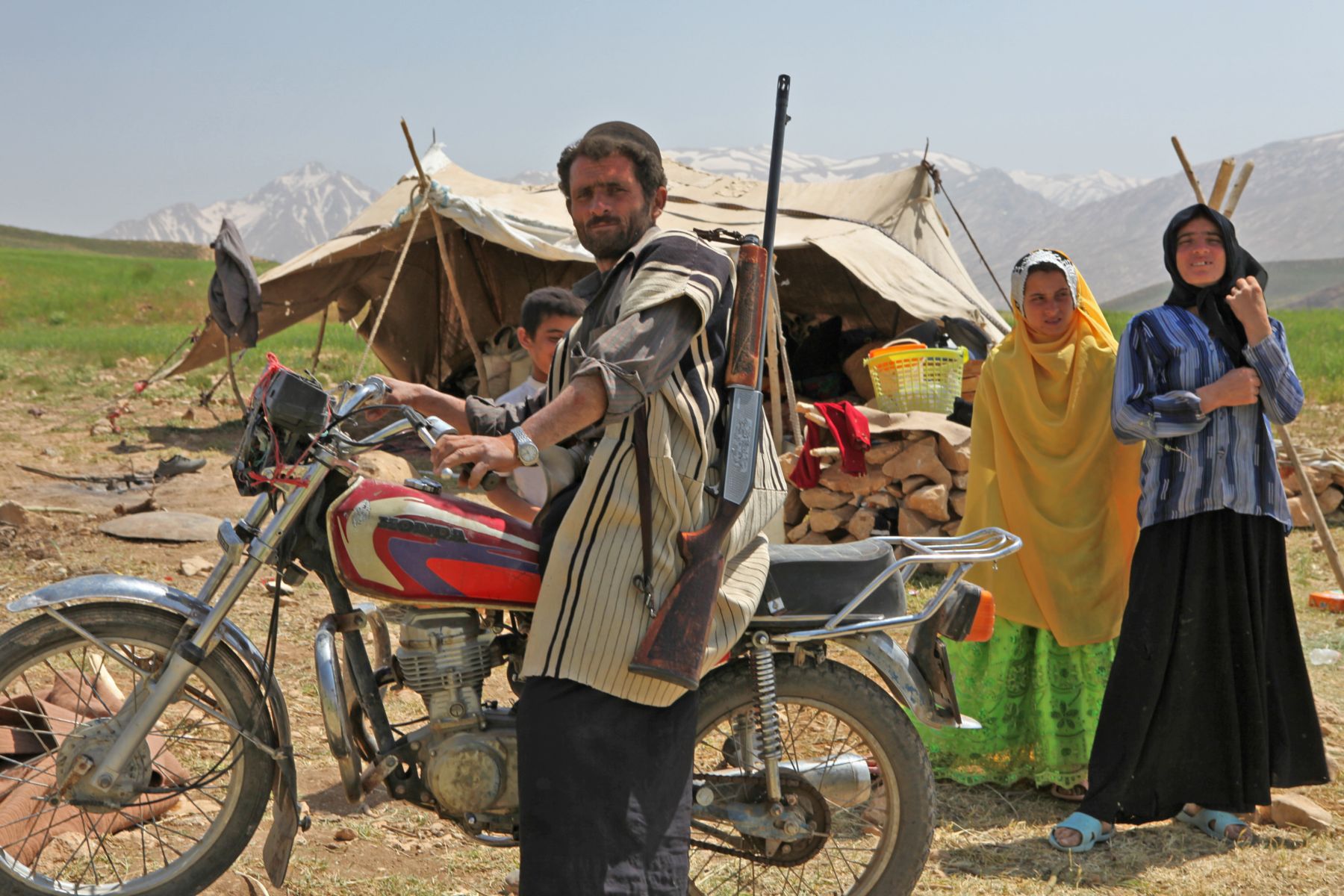
The Bakhtiari are the classic example of Iranian pastoral nomadism: twice a year whole families move their flocks of sheep and goats, horses and donkeys along ancestral migration roads (il-rah) between the Khuzestan lowlands and the Zagros highlands, crossing the Karun and Bazoft rivers and passes above 3,000 m; the 1925 film 'Grass' recorded this migration. Families live in black goat-hair tents in the mountains and stone houses or settled villages in winter. The men's dress is the chugha, a white or striped woven wool cloak, over wide black trousers, with a round felt cap (kolah); women wear long colourful dresses, layered skirts and a scarf tied under a small cap, and weave the famous Bakhtiari carpets with garden-panel designs, kilims and the chugha cloth itself. Weddings include stick-fighting dances (tarka-bazi, chub-bazi) and handkerchief dances to sorna and dohol, and horsemanship and marksmanship are prized. Mourning is marked by women's sung laments (gagriw) and, historically, by carved stone lions (shir-e sangi) placed on the graves of brave men. Hospitality, honour and loyalty to the tribe and its khans are core values, and elders still arbitrate disputes and arrange marriages, which are usually within the tribe.

Religious practices

The Bakhtiari are Twelver Shia, observing Muharram with mourning gatherings and processions, and many make pilgrimage to Mashhad, Qom and Karbala. Their religion has long been described as less clerical than that of the towns: nomad camps rarely had mullahs, and religious life centred on vows (nazr), sacrificing sheep for blessing, visits to local shrines and imamzadehs along the migration routes, and the honouring of ancestors and warrior dead, whose graves were marked with stone lions. Folk beliefs about the evil eye, spirits and protective amulets remain common among older and rural people. Since the revolution, state religious institutions have expanded in Shahr-e Kord, Masjed Soleyman and Izeh, while urban youth show the same drift away from formal religion seen across Iran.

Gospel access

Bakhtiari has Scripture portions (2020 according to Joshua Project's language data), the JESUS Film, an 'Acts' video in 44 segments, and text and audio on Bible.is (Wycliffe version); Global Recordings Network also has Bakhtiari recordings. Persian Bibles, satellite Christian television and online ministries reach Bakhtiari, nearly all of whom are bilingual in Persian. Joshua Project records 0.2% evangelical, one of the few Lur groups with any known believers, though no public church exists.

The Bakhtiari and the Constitutional Revolution

In 1909, during the Constitutional Revolution, Bakhtiari tribal forces led by Ali-Qoli Khan Sardar As'ad and Najafqoli Khan Samsam al-Saltaneh advanced from Isfahan and, together with the Gilan revolutionaries, took Tehran and deposed Mohammad Ali Shah. Bakhtiari khans then dominated the government for several years: by 1912 they governed seven cities, Sardar As'ad served as minister of war, and Samsam al-Saltaneh was prime minister. Their territory also held the 1908 oil strike at Masjed Soleyman, and the khans drew royalties from the Anglo-Persian Oil Company. Reza Shah ended their autonomy, executed or imprisoned several khans, banned tribal dress and forced the tribes to settle in the 1930s; many resumed migration after his abdication in 1941.

The Great Migration and the Film 'Grass'

The Bakhtiari migration (kuch) is one of the world's most demanding pastoral journeys: tens of thousands of people and their flocks walk for weeks along fixed tribal roads (il-rah), crossing the Karun and Bazoft rivers on rafts or by swimming and climbing snowbound passes of the Zard Kuh range. The 1925 documentary 'Grass: A Nation's Battle for Life' by Merian C. Cooper and Ernest Schoedsack filmed the Baba Ahmadi section's migration and made the Bakhtiari internationally known; the anthropologist Jean-Pierre Digard called them the most complete example of Iranian nomadism.

At a glance

Language
Bakhtiari
Language family
Indo-European
Affinity bloc
Central Asian Peoples
People cluster
Luri-Bakhtiari
Primary religion
Islam - Shia
Bible status
Portions
Jesus Film
Yes
Audio recordings
Yes
Gospel recordings
Available
Radio broadcasts
Not Available
Religious school
Ja'fari

Religious breakdown

Religion % DenominationNotes
Islam95%+Shia (Twelver, Ja'fari)Dominant identity; Muharram mourning central
Islam (folk practice)widespreadShia folk religionVows, shrine visits, stone-lion grave markers and warrior cult of the dead, protective amulets
Non-religious / secularunknownUrban and educated youth, as nationally
Christianity0.2%EvangelicalSmall number of converts

Presence by country

IranNativeVerified presence
Population
1,336,000
Location
Chaharmahal and Bakhtiari (summer pastures: Shahr-e Kord, Farsan, Kuhrang, Ardal, Lordegan); eastern Khuzestan (winter pastures: Masjed Soleyman, Izeh, Lali, Andika, Bagh-e Malek); western Isfahan; southeastern Lorestan (Aligudarz)

The Bakhtiari are the largest Lur tribal confederation, about 1.3 million people of the central Zagros between Isfahan and the Khuzestan plain. Divided since medieval times into the Haft Lang and Chahar Lang moieties, they are the classic Iranian nomads: each spring and autumn families still drive flocks over passes above 3,000 m and across the Karun and Bazoft rivers between the lowland winter pastures and the summer pastures below Zard Kuh. Men wear the striped wool chugha cloak and round felt cap, and Bakhtiari women weave carpets with distinctive garden-panel designs. Bakhtiari khans helped win the Constitutional Revolution in 1909, and the first Middle Eastern oil was struck on their land at Masjed Soleyman in 1908. Most are now settled, and drought and the transfer of their rivers' water to Isfahan are central grievances.

Photos

Bakhtiari (Joshua Project profile photo)
Bakhtiari nomads moving goats and sheep in Bazoft
A Bakhtiari nomad family in Chaharmahal and Bakhtiari
Traditional Bakhtiari tribal wedding
A Bakhtiari nomad camp in Bazoft
Weave of the chugha, the Bakhtiari men's cloak
Map of counties with Bakhtiari nomad presence

Videos

Sources

  1. Bakhtiari people - Wikipedia
  2. Deaths reported during widening protests in Iran - KJZZ/AP (1 Jan 2026)
  3. D-PLACE Ethnographic Atlas - Bakhtiari (Ea8)
  4. Glottolog - Bakhtiari (bakh1245)
  5. In this nomadic tribe in Iran, the women persevere despite hardships - NPR/Michigan Public (2022)
  6. Joshua Project - Bakhtiari in Iran
  7. Promises of water to Esfahan fueling protests elsewhere in Iran - Iran International (2021)
  8. Scripture Earth - Bakhtiari (bqi)
  9. آغاز رسمی کوچ عشایر بختیاری - IRIB News
  10. ایل بختیاری - Persian Wikipedia
  11. جمعیت عشایر چهارمحال و بختیاری - IANA
  12. زمان کوچ عشایر چهارمحال و بختیاری ۲۰ اردیبهشت ۱۴۰۴ - IRIB Ahvaz (2025)