People groups
Ilsavan

Ilsavan

JPIMBGRNDiscovery
Countries
2
Language
Turkish
Religion
Islam - Shia
Bible status
Complete Bible

Locations

Identity

The Shahsevan ("those who love the shah" in Turkic) are a confederation of Turkic tribes of Iranian Azerbaijan, centred on Ardabil, Meshginshahr and the Moghan steppe. Tradition says Shah Abbas I (r. 1588-1629) created them as a loyalist force against unruly Qizilbash chiefs, but historians such as Minorsky and Tapper doubt it: the name appears in the 16th century, and the confederacy took shape in the 18th, when Nader Shah (1732) united the tribes under Badr Khan Shahsevan. Russian sources trace some lineages to Anatolia. The tribes fought and lost pasture in the Russo-Persian wars, saw their winter grazing cut by the Aras border after 1828, sacked Ardabil in 1909 and were disarmed by Reza Khan in 1922-23.

By their own count they had 32 tribes in Meshgin and 13 around Ardabil (other counts give 11 tribes of 90 camps, or over 60 tribes), with names such as Qojabeyli, Isali, Balabeyli, Ajirli, Polatli, Damirchili, Beydili, Jafarlu and Sarikhanlu. Society runs from tribe to clan, gobak (20-30 families) and oba (camp), led by elders (aqsaqal) and formerly by beys and khans. After the 1979 revolution the state renamed them Ilsevan ("those who love the people"), the source of the name Ilsavan; it had lapsed by 1992. Branches outside the Ardabil heartland include the Khamseh Shahsevan of Zanjan and the Baghdadi Shahsevan and Inanlu of Qazvin, Saveh and Varamin, and a small population lives in the Azerbaijan Republic.

They speak Azerbaijani; Glottolog lists Shahsavani as a dialect of South Azerbaijani. Encyclopaedia Iranica and Wikipedia describe the Shahsevan as a sub-ethnic group of the Azerbaijanis, and the name today chiefly means the tent-dwelling nomads: families who settle tend to drop it and identify as Azerbaijani Turks.

Culture & traditions

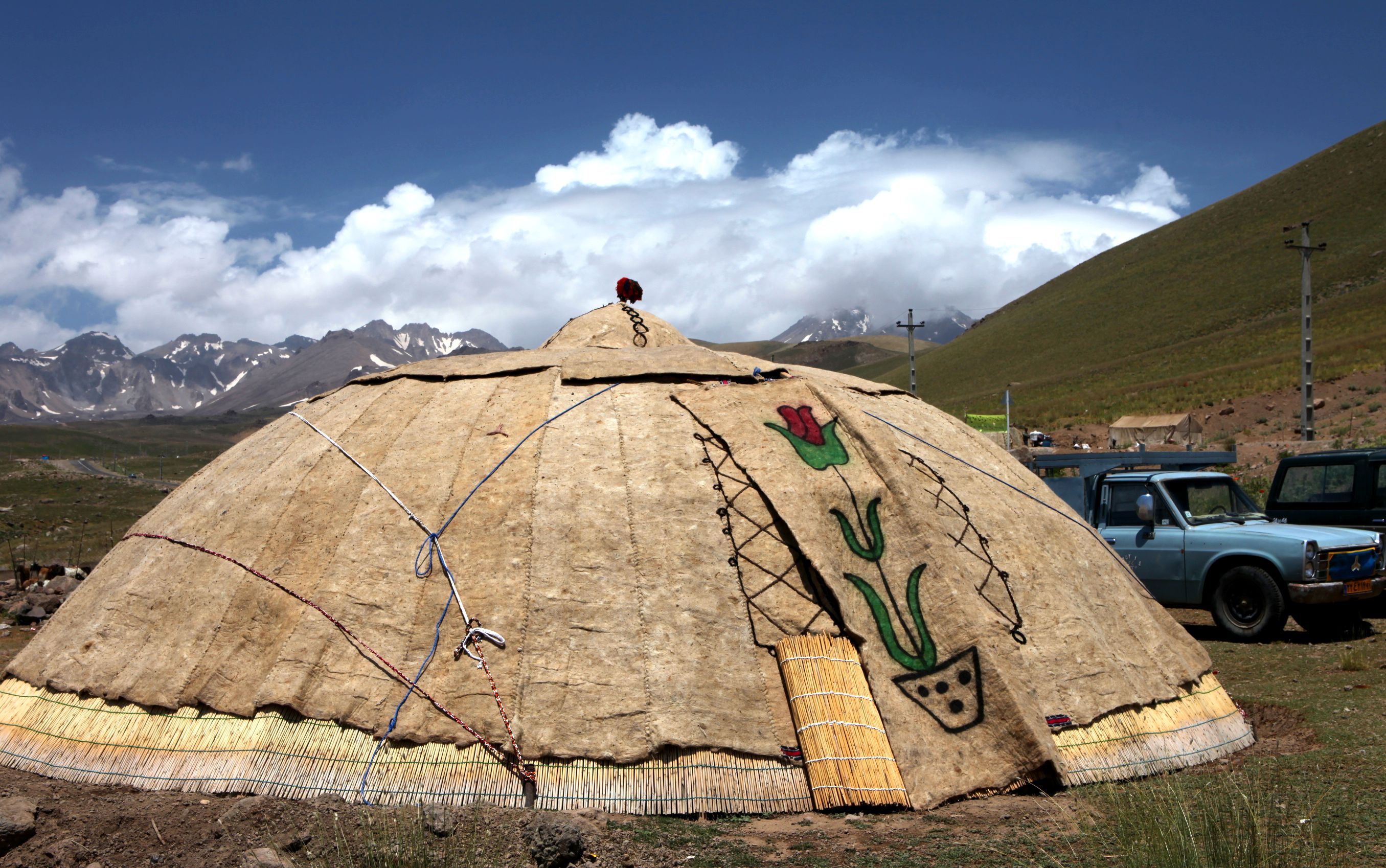
The emblem of Shahsevan life is the alachiq, a dome-shaped felt tent on a frame of 23-28 curved wooden poles, of Central Asian design; a smaller rectangular kuma serves for cooking and dairy work. Camps of related families move twice a year: in mid-June up to the pastures of Mount Sabalan (4,811 m), a journey of 15-20 days, and from mid-September down to the Moghan steppe near the Aras River, over 40-45 days, some 400 km in all, with sheep, goats, cattle, horses and two-humped camels.

Women weave the textiles for which the Shahsevan are famous: kilims, jajim, sumak bags and horse covers, verni flatweaves, felt and knotted rugs. Women's dress has nine pieces, including a long coloured shirt, pleated skirts, the arkhalig jacket, a flowered headscarf and a vest hung with coins that shows the family's wealth; men once shaved their heads, kept temple locks and wore lambskin hats and Circassian coats. Food is mutton, rice pilaf, bread baked on the saj and a wide range of dairy products. Elders negotiate marriages, and weddings can last for days, ending with guests' cash gifts. Ashiq bards sing epics and love songs to the saz. Nowruz is kept with Chaharshanbe Suri fire-jumping and dyed eggs, and some pre-Islamic funeral customs survive.

Religious practices

The Shahsevan are Twelver Shia, and their founding legend ties them to the Safavid shahs who made Iran Shia. Practice is that of rural Azerbaijani Shiism: Muharram and Ashura mourning, Ramadan, vows and votive meals (nazr), visits to imamzadehs and to the Safavid shrine of Sheikh Safi al-Din in Ardabil, and pilgrimage to Mashhad and Karbala when means allow. Camps on the move rely less on mosques and more on household and seasonal ritual, with mullahs from nearby villages called for weddings and funerals. Older customs persist alongside Islam: protective charms against the evil eye, Nowruz fires, and funeral rites that ethnographers trace to pre-Islamic Turkic practice. Settled and urban Shahsevan share the wider Iranian drift away from institutional religion; no study measures it among them.

Gospel access

The complete Bible exists in South Azerbaijani, which the Shahsevan speak (Elam New Testament 2013, Old Testament 2014; Institute for Bible Translation text 2008), with the JESUS film and Global Recordings Network and Faith Comes By Hearing audio. Global Recordings Network lists "Shahsavani" as a people group but holds no dialect-specific recordings. Joshua Project estimates 0.5% Christian adherents and 0.2% evangelical; no Shahsevan church or believer community is publicly known. Nomadic camps are hard to reach, often out of mobile range, and tightly knit.

At a glance

Language
Turkish
Language family
Turkic (Oghuz)
Affinity bloc
Turkic Peoples
People cluster
Azeri
Primary religion
Islam - Shia
Bible status
Complete Bible
Jesus Film
Yes
Audio recordings
Yes
Gospel recordings
Yes
Radio broadcasts
No
Religious school
Ja'fari (Twelver Shia)

Religious breakdown

Religion % DenominationNotes
Islam~99%Shia (Twelver)Muharram mourning, vows, shrine visits; folk customs around Nowruz, the evil eye and funerals
Christianity~0.5%Evangelical (house churches)JP estimate (0.2% evangelical); no Shahsevan church publicly known

Presence by country

IranNativeVerified presence
Population
~100,000-300,000
Location
Ardabil Province (Meshginshahr, Ardabil, Moghan plain, Mount Sabalan); scattered branches in Zanjan, Qazvin, Saveh and Varamin

The Shahsevan are a confederation of Azerbaijani-speaking Shia Turkic tribes of Iran's far northwest, said to have been founded as loyal servants of the Safavid shahs, which is what their name, "those who love the shah", means. Tens of thousands of them still live as pastoral nomads, moving their flocks and dome-shaped felt tents (alachiq) between the low Moghan steppe on the Aras River in winter and the high pastures of Mount Sabalan in summer, a round trip of some 400 km. Their women weave kilims, sumak bags and verni flatweaves prized by collectors. Most people of Shahsevan descent have settled in villages and towns and now see themselves simply as Azerbaijani Turks, while drought and rising costs are pushing more herding families to give up the migration.
Also found outside the Middle East and North Africa

Azerbaijan

Photos

Ilsavan (Shahsevan) in Iran
A Shahsevan alachiq felt tent in Meshginshahr County
Interior decorations of a Shahsevan tent, Ardabil Province
A Shahsevan girl in traditional dress
Shahsevan girls from a rich family, late 19th century

Videos

Sources

  1. Chai Khana: Nomadic life under threat in Iran (2017)
  2. Encyclopedia of World Cultures: Shahsevan, Orientation
  3. Glottolog: Shahsavani (shah1257)
  4. IMB GSEC listing 2013-2015: Shahseven (PEID 24214)
  5. Joshua Project: Ilsavan in Iran
  6. Kojaro: Shahsevan nomads
  7. Mehr News: 30% of Ardabil's Shahsevan nomads left herding (8 June 2023)
  8. Persian Wikipedia: ایل شاهسون
  9. Richard Tapper, Frontier Nomads of Iran: A Political and Social History of the Shahsevan (Cambridge UP, 1997)
  10. Smithsonian HSFA: The Shahsavan Nomads of Iran (1984)
  11. Tabnak: Snow clearing of nomad routes (23 July 2018)
  12. Tasnim: Ardabil nomads produce 14,000 sq m of handicrafts (9 March 2016)
  13. Wikipedia: Şahsevən, Aghjabadi
  14. Wikipedia: Shahsevan