People groups
Armenian

Armenian

JPIMBGRN
Population in the Middle East and North Africa
9,600
Countries
37
Language
Armenian
Religion
Christianity - Armenian Apostolic
Bible status
Complete Bible

Locations

Identity

Armenians are an Indo-European people native to the Armenian Highlands (eastern Anatolia and the South Caucasus). They are one of the world's oldest civilizations, with a written history extending over 2,500 years. Armenia adopted Christianity as a state religion in 301 CE, making it the first Christian nation. The Armenian Apostolic Church (Oriental Orthodox tradition) is integral to Armenian national identity. The 1915 genocide by the Ottoman Empire killed an estimated 1.5 million Armenians and created a massive global diaspora. Eastern Armenian is the language of Armenia and of Iran's Armenians, while Western Armenian, the dialect of the historic Ottoman Armenian community, is the language of most diaspora communities in the Arab world.

Culture & traditions

Armenian community life revolves around the Armenian Apostolic and Catholic churches. Cultural institutions include social clubs, sporting clubs, dance troupes, choirs, and schools. Armenian cuisine features lavash bread, dolma, khorovats (barbecue), and baklava. The April 24 genocide commemoration is the most important communal observance. Armenian language and cultural preservation are major community priorities, though younger diaspora generations increasingly shift to the host country's language.

Religious practices

The Armenian Apostolic Church follows the Oriental Orthodox tradition, distinct from both Eastern Orthodox and Roman Catholic churches. The liturgy uses Classical Armenian (Grabar). Key observances include Christmas on January 6 (not December 25), Easter, and the Feast of the Holy Translators. The church is the primary gathering point for diaspora community life. Armenian Catholic and Evangelical communities also exist within the diaspora.

Gospel access

Full Bible available in Eastern Armenian, the language of Armenia and of Iran's Armenians, and in Western Armenian, the language of most diaspora communities; the liturgy uses Classical Armenian (Grabar). Jesus Film available in Armenian. GRN audio recordings available. The Armenian community is overwhelmingly Christian — the gospel access question is about denominational engagement rather than initial access. Armenian Evangelical churches exist in most major diaspora communities.

At a glance

Language
Armenian
Language family
Indo-European
Affinity bloc
European Peoples
People cluster
Armenian
Primary religion
Christianity - Armenian Apostolic
Bible status
Complete Bible
Jesus Film
Yes
Audio recordings
Yes
Gospel recordings
Available
Radio broadcasts
Not Available
Religious school
Oriental Orthodox

Religious breakdown

Religion % DenominationNotes
Christianity85-90%Armenian Apostolic (Oriental Orthodox)Majority denomination; anchor of community identity
Christianity5-10%Armenian CatholicEastern Catholic church in communion with Rome
Christianity2-3%Armenian Evangelical/ProtestantSmall community

Presence by country

EgyptNativeVerified presence
Population
~6,000 (3,000-10,000)
Location
Cairo (Heliopolis, downtown), Alexandria

Egypt's Armenians are a Christian community of generations, most of them Egyptian citizens, whose families came as merchants and officials under Muhammad Ali and as survivors of the 1915 Armenian Genocide; Nubar Pasha, Egypt's first prime minister, was Armenian, and the Armenian General Benevolent Union was founded in Cairo in 1906. About 6,000 remain, down from some 40,000 before the 1950s nationalizations drove families abroad, and they speak Western Armenian at home and Arabic outside it. Life centres on Apostolic, Catholic and Evangelical churches in Cairo and Alexandria, the Kalousdian-Nubarian school in Heliopolis, sports and cultural clubs and the newspapers Housaper and Arev. Armenian jewellers are still a byword in Cairo, and khorovats grilled meat with lavash bread is served at community feasts.

IranNativeVerified presence
Population
~40,000-70,000
Location
Tehran (about three-quarters), Isfahan's New Julfa, Tabriz, Urmia, Fereydan (Peria) villages; small parishes in Arak, Shiraz, Rasht and Ahvaz

Armenians are Iran's oldest and largest Christian community, native to the country's northwest for millennia and reshaped in 1604-05 when Shah Abbas I resettled Armenians from Julfa on the Aras River in New Julfa, a purpose-built quarter of Isfahan. Today roughly 40,000 to 70,000 remain, about three-quarters of them in Tehran, down from 200,000 or more before 1979 as families have left for the United States and Armenia. They speak a distinctive Iranian dialect of Eastern Armenian, run their own schools, sports clubs and the daily newspaper Alik, and hold two reserved seats in parliament. The Armenian Apostolic Church may worship freely in Armenian but may not hold services in Persian or receive Muslim converts. Each July thousands of pilgrims gather at the black-stone Monastery of Saint Thaddeus near the Turkish border, the largest Christian gathering in the country.

IraqNativeVerified presence
Population
~5,000-10,000
Location
Duhok governorate (Zakho, Avzrog, Havresk, Duhok city), Erbil and Ankawa, Baghdad, Basra; a few families in Kirkuk and Mosul

Iraq's Armenians are mostly descendants of survivors of the 1915 Armenian Genocide who fled south from Anatolia, joining a much older merchant colony in Basra. Before 2003 there were perhaps 20,000; violence and emigration have reduced them to between 5,000 and 10,000, with the Baghdad community shrinking from thousands to a few hundred families and Mosul's almost disappearing. The Kurdistan Region has become their refuge: about 3,000 live in Zakho, Duhok, Erbil and the farming villages of Avzrog and Havresk, where many speak Kurdish at home and sermons are preached in Kurdish or Arabic. They belong to the Armenian Apostolic Church, and in 2024 a century-old Armenian church in Zakho was restored and reopened.

IsraelNativeVerified presence
Population
4,600
Location
Jerusalem (Armenian Quarter of the Old City), Haifa, Jaffa (Tel Aviv), with immigrant families in other cities

Armenians have lived in Jerusalem since the fourth century, and their patriarchate, founded in 638, still governs a walled Armenian Quarter that covers about a sixth of the Old City. Most of today's Jerusalem Armenians descend from survivors of the 1915 genocide who were sheltered in the St James monastery, and they are known for the hand-painted Armenian ceramics sold across the city and for the photographers who documented the Holy Land from the 1850s. Haifa and Jaffa have smaller communities, now made up largely of families from Soviet Armenia who arrived after 1990 with Jewish spouses or relatives. The Jerusalem community, many of whom hold residency but not citizenship, has spent recent years fighting a 2021 lease that would hand a quarter of the Armenian Quarter to a developer.

JordanNativeVerified presence
Population
~3,000-5,000
Location
Jabal al-Ashrafieh (Armenian quarter), Amman; small numbers in Zarqa, Irbid, Madaba, Aqaba

Armenians in Jordan are the descendants of survivors of the 1915 genocide who settled in Ma'an, Karak and Amman, joined after 1948 by Armenians from Jerusalem, and today number about 3,000 to 5,000. They are Jordan's largest non-Arab Christian community, belonging mostly to the Armenian Apostolic Church under the Patriarchate of Jerusalem. Their quarter on Jabal al-Ashrafieh, one of Amman's highest hills, holds St. Thaddeus church, an Armenian Catholic church, Armenian schools and scout and sports clubs, and each April the community marks the genocide. Once about 10,000 strong, the community has shrunk as families emigrated to Australia, Canada and the United States.

LebanonNativeVerified presence
Population
~60,000-100,000
Location
Bourj Hammoud and the Metn coast (Antelias, Naccache, Dbayeh, Fanar, Mezher), Achrafieh and Mar Mikhael in Beirut, Anjar and Zahle in the Bekaa

Lebanon's Armenians descend from survivors of the 1915 genocide who were settled on the marshland of Bourj Hammoud east of Beirut, and from the villagers of Musa Dagh who founded Anjar in the Bekaa in 1939 when Alexandretta passed to Turkey. They became citizens in 1924 and are the one Christian community in Lebanon that is not Arab: they speak Western Armenian at home and keep about a dozen Armenian schools, three daily newspapers and Haigazian University, the only Armenian university outside Armenia. The Catholicosate of Cilicia, one of the two supreme sees of the Armenian Apostolic Church, has its seat at Antelias, and the community holds six seats in parliament. Bourj Hammoud's narrow streets of jewellers, shoemakers and leather workshops are still called Little Armenia, though the civil war, the 2019 financial collapse and the 2020 port explosion have sent many families to Armenia, Canada, France and the United States.

SyriaNativeVerified presence
Population
~15,000-25,000
Location
Aleppo (Midan, Suleimaniyeh, Jdeydeh, Villaner, Sheikh Taha), Kessab and Latakia on the coast, Damascus, and Qamishli, Hasakah and al-Malikiyah in the Jazira

Syria's Armenians descend mostly from survivors of the 1915 genocide, whose death marches ended in the desert around Deir ez-Zor, and from refugees who left Cilicia and Alexandretta between 1921 and 1939; an older community had lived in Aleppo since the Middle Ages. Aleppo became the largest Armenian city in the Arab world, with its own quarters, a dozen schools, the Forty Martyrs Cathedral and a weekly paper, while Kessab, a pine-forested mountain town on the Turkish border, has been Armenian for centuries. They speak Western Armenian at home and Arabic in public, and belong to the Armenian Apostolic Church with Catholic and Evangelical minorities. About 100,000 before 2011, the community has shrunk to perhaps a fifth of that through emigration to Armenia, Lebanon and the West, and Armenian schools now take Arab Christian pupils to stay open.

Türkiye (Turkey)NativeVerified presence
Population
~60,000-90,000
Location
Istanbul (almost all); Vakıflı village in Hatay; a few families in İskenderun, Diyarbakır, Kayseri and Ankara

The Armenians of Istanbul are the last organised remnant of a people who lived across Anatolia for some 2,500 years and numbered close to two million before the genocide of 1915-1923. Today about 50,000 to 70,000 Armenian citizens remain, almost all in Istanbul, around the Patriarchate in Kumkapı, in Kurtuluş, Feriköy, Şişli, Bakırköy and Yeşilköy, and on the Princes' Islands in summer; they are joined by thousands of women from the Republic of Armenia who work as carers and domestic staff. As one of three minorities recognised by the 1923 Treaty of Lausanne they run their own churches, 16 schools, two hospitals and the bilingual weekly Agos, whose editor Hrant Dink was murdered in 2007. Western Armenian, the language of the Ottoman Armenians, is spoken by a shrinking share of the young. In Hatay the village of Vakıflı, at the foot of Musa Dağ, is the only Armenian village left in the country, its church rebuilt after the 2023 earthquakes.

KuwaitDiasporaVerified presence
Population
5,000
Location
Kuwait City area: Salmiya (Sts Vartanantz Church, prelacy) and Surra (Armenian School)

Kuwait's Armenians are descendants of genocide survivors who had rebuilt their lives in Syria, Lebanon and Iran and then came to Kuwait from the late 1940s as engineers, contractors and skilled craftsmen during the oil boom. They grew to about 12,000 by the mid-1980s, fell to roughly 500 after the 1990 Iraqi invasion, and have slowly rebuilt to around 5,000. The community gathers around the Sts Vartanantz Church in Salmiya, seat of the Armenian Apostolic prelacy for the whole Gulf, and the Armenian School, which has taught children from kindergarten to grade 12 in Armenian since 1960. As one of the few Christian peoples in Kuwait with their own church, school and clubs, they keep a distinct language, liturgy and social life within a Muslim society.

QatarDiasporaVerified presence
Population
~700-1,500
Location
Doha

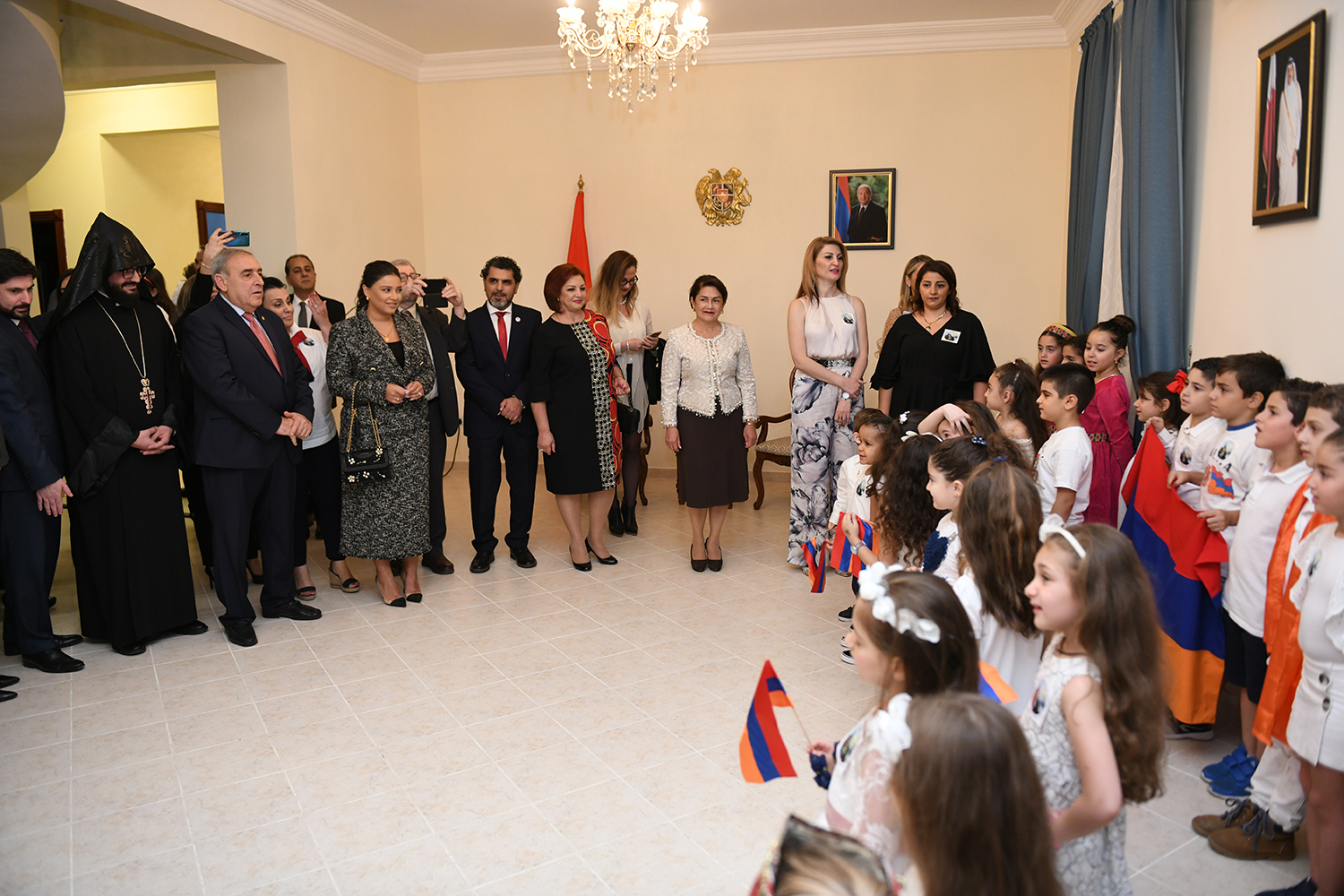
Qatar's Armenians are a small community of professionals, mostly descendants of genocide survivors who had settled in Lebanon and Syria, joined since the 1990s by Armenians from Armenia, Iran and Russia. They numbered about 170 when they first organised in 2004 and about 700 by 2009, and Armenia opened an embassy in Doha in 2019. As Armenian Apostolic Christians without a church of their own, they gather for Christmas and Easter liturgies in the Coptic church of Doha, led by clergy visiting from the Gulf prelacy, and volunteer parents run the Mesrobian Saturday school so that children who speak English and Arabic better than Armenian still learn their language. The Emir granted land for an Armenian church in 2011, and the head of their church, Catholicos Aram I, visited the community again in 2024.

United Arab EmiratesDiasporaVerified presence
Population
~6,000-10,000
Location
Dubai, Sharjah and Abu Dhabi (Musaffah), with scattered families elsewhere

Armenians in the Emirates, perhaps 6,000 to 10,000 people, are a Christian community that began in the 1960s with engineers, managers, jewellers and traders whose families had survived the genocide and settled in Lebanon and Syria, joined in the last fifteen years by newcomers from Armenia, Iran and Russia. On land granted by the rulers of Sharjah and Abu Dhabi they built the St Gregory the Illuminator church in Sharjah (1998) and the Holy Martyrs church in Abu Dhabi (2014), and a third church is rising in Dubai. Each complex houses a one-day-a-week school, where some 280 children, many of them from mixed marriages, learn Western Armenian, history and the faith from volunteer teachers. The established Lebanese and Syrian Armenian families run the church and school life, while many newcomers from Armenia keep apart from it.

Also found outside the Middle East and North Africa

Armenia, Azerbaijan, Argentina, Australia, Belarus, Belgium, Brazil, Bulgaria, Canada, France, Georgia, Germany, Greece, Italy, Kazakhstan, Poland, Russia, Spain, Tajikistan, Turkmenistan, Ukraine, United Kingdom, United States, Uruguay, Uzbekistan, Venezuela

Photos

Armenian
Armenian
Vank Cathedral in New Julfa, the Armenian quarter of Isfahan, Iran
St. Sarkis Armenian Cathedral, Tehran
Qara Kelisa, the Monastery of St. Thaddeus, West Azerbaijan, Iran
Shoghakat Armenian Church, Tabriz
Armenian women in Qajar-era Iran
Armenian church in Jabal al-Ashrafieh, Amman, Jordan
St. Garabed Armenian church at the Baptism Site on the Jordan River
Street in Bourj Hammoud, Beirut's Armenian quarter, with a portrait of Charles Aznavour
Street sign in Arabic, English and Western Armenian for the Armenian Evangelical school and church, Anjar, Lebanon (2026)
Armenian community of Qatar meets President Khachaturyan at the embassy in Doha (May 2023)
Pupils of the Mesrobian Armenian school, Doha (Nov 2019)
Surp Asdvadzadzin church in Vakıflı, Türkiye's last Armenian village (Hatay)
Funeral march for Hrant Dink, Istanbul, January 2007
Surp Krikor Lusavoriç Armenian Church, Türkiye
Forty Martyrs Armenian Apostolic Cathedral, Aleppo, Syria
Holy Trinity Armenian Evangelical Church, Kessab, Syria
Kessab, Syria (2010)

Videos

Sources

  1. AGBU: The Armenians of Kuwait, rebuilding after the Gulf War
  2. AGBU: The Forgotten Armenians of Iraqi Kurdistan (2016)
  3. Agos: Pashinyan meets Armenian community, Patriarchate a no-show
  4. Al Jazeera — Armenian Christians in Jerusalem's Old City feel the walls closing in (Dec 2024)
  5. Al Jazeera: Armenians in Palestine face uncertain future (25 Apr 2015)
  6. Anadolu: Armenian community in Syria sees future with optimism (7 Dec 2025)
  7. An-Nahar: The path of Armenians in Lebanon (6 Jan 2026, Arabic)
  8. Arabi21: Armenians brought photography and printing to Palestine and are part of its identity (24 Oct 2022)
  9. Armenian Diaspora Survey: Cairo
  10. Armenian Diaspora Survey: Lebanon
  11. Armenian Embassy in Egypt
  12. Armenian Embassy in Egypt: Armenia-Egypt relations (2020)
  13. Armenian MFA: Armenia-Qatar bilateral relations
  14. Armenian Prelacy: Catholicos Aram I highlights accomplishments of Dubai community (Feb 2024)
  15. Armenian Prelacy: Catholicos Aram I meets government officials, diplomats in Qatar (18 Jan 2024)
  16. Armenian Prelacy: Catholicos Aram I visits Kuwait (May 2023)
  17. Armenian Prelacy: The very future of Christianity is at stake in its birthplace, Catholicos Aram I (May 2026)
  18. Armenian Weekly: Aleppo's Armenians in a changing Syria (28 Mar 2025)
  19. Armenian Weekly: Armenian neighborhoods in Iran and Lebanon hit (16 Mar 2026)
  20. Armenian Wikipedia: Հայերը Կատարում
  21. Armenia-Turkey Expert Dialogue Group policy brief (2018) via CRRC
  22. Armenpress: Aram I consecrates Armenian Church in Abu Dhabi (Dec 2014)
  23. Armenpress: Impressive diversity within UAE's Christian community (Nov 2022)
  24. Armenpress: President Sarkissian hosted at Armenian Embassy in Doha (19 Nov 2019)
  25. Azad-Hye: Christmas Holy Mass in Doha (10 Feb 2012)
  26. Azad-Hye: Doha Armenians continue active community life (12 Jun 2009)
  27. Azad-Hye: Emir of Qatar grants a piece of land to Armenians to build a church (18 Mar 2011)
  28. Azad-Hye: Kuwaiti Armenian School's 50th anniversary
  29. Azad-Hye: Many leave for economic reasons, others stay to preserve identity
  30. Azad-Hye: Mesrobian Saturday School's New Year celebration in Doha (Dec 2011)
  31. Azad-Hye: Qatari Armenians get organized (2004)
  32. Azatutyun: Syrian Armenians expect aid from Yerevan (11 Dec 2024)
  33. Azatutyun: Yerevan 'unable' to help Armenians in Syria's Aleppo (2 Dec 2024)
  34. bianet: Armenian community in Hatay celebrates feast at church restored after earthquakes
  35. bianet: Turkey's last Armenian village faces expropriation threat
  36. bianet: Turkey's last Armenian village stands strong with its women after earthquakes
  37. Carnegie Diwan: Don't underestimate Lebanon's Armenians (Jul 2025)
  38. Chake Mangassarian-Menkechian: The Peculiarities of the Current Stage of Development of the Armenian Community in the UAE (2025)
  39. Coptic Solidarity / Agos: Syrian Christians, life between war and migration (2022)
  40. Daraj: Iraqi Armenians, a minority on the brink of extinction
  41. Egyptian Streets: Armenian Community (2022)
  42. GLMM: Non-Kuwaiti population by migration status and country of citizenship (2012)
  43. Gulf News: First Armenian church opens in Abu Dhabi (2014)
  44. Hrant Dink Foundation: Armenian Citizen Migrants in Turkey
  45. Jerusalem Post: Armenian Church in Holy Land celebrates latest Christmas in the world (20 Jan 2019)
  46. Joshua Project: Armenian in Egypt
  47. Joshua Project: Armenian in Kuwait
  48. KirkukNow: Armenians of Dohuk upset, our seat in Kurdistan parliament gone (Jun 2024)
  49. MECC: His Holiness Catholicos Aram I arrives to Qatar (10 Jan 2024)
  50. MECC: The meetings of His Holiness Catholicos Aram I in Qatar (12 Jan 2024)
  51. Mil Hilard — Save the Armenian Quarter leader welcomes lease rejection by the General Assembly (2025)
  52. NPR: It's a dangerous time for Christians in northeastern Syria (2020)
  53. Palestine Studies: Armenians of Jerusalem (undated)
  54. PanArmenian (31 Jan 2025)
  55. PanArmenian: Abbas, Armenians will always remain in Jerusalem, Ramallah and Bethlehem (Jan 2016)
  56. PanArmenian: Aleppo Armenian districts during January 2026 fighting
  57. Persecution.org: Iran moves to seize historic Tehran church (8 Jul 2026)
  58. President of Armenia met the Armenian community in Egypt (November 2025)
  59. President of Armenia: Nouneh Sarkissian met students of Mesrobian school (18 Nov 2019)
  60. President of Armenia: Vahagn Khachaturyan met with Armenian community in Qatar (26 May 2023)
  61. Religious composition of Iran 2016 (SCI census by province)
  62. Rudaw: Armenian Christian population in Iraq sees drastic decline (7 Jan 2025)
  63. SOAR Amman Chapter
  64. Syriac Press: 101-year-old Armenian church restored in Zakho (20 May 2024)
  65. Syriac Press: Kessab, Syria's enduring Armenian enclave (29 Aug 2025)
  66. Syriac Press — Tensions in Jerusalem's Armenian Quarter continue (June 2025)
  67. The Media Line: Young Lebanese Armenians fight to preserve their historic identity (2023)
  68. US State Department: 2023 Report on International Religious Freedom, Iraq
  69. WFN: Armenian Patriarchate statement on the Bethlehem monastery (April 2002)
  70. Wikipedia: 2022 Lebanese general election in Beirut I
  71. Wikipedia: Anjar, Lebanon
  72. Wikipedia: Armenian population by country
  73. Wikipedia: Armenians in Egypt
  74. Wikipedia — Armenians in Haifa
  75. Wikipedia: Armenians in Iraq
  76. Wikipedia — Armenians in Israel and Palestine
  77. Wikipedia: Armenians in Jordan
  78. Wikipedia: Armenians in Kuwait
  79. Wikipedia: Armenians in Lebanon
  80. Wikipedia: Armenians in Qatar
  81. Wikipedia: Armenians in Syria
  82. Wikipedia: Armenians in the United Arab Emirates
  83. Wikipedia: Armenians in Turkey
  84. Wikipedia: Iranian Armenians
  85. Wikipedia: Jabal al-Ashrafieh
  86. Wikipedia: Kessab
  87. Wikipedia — Saint Nicholas Monastery, Jaffa