People groups
Qashqai

Qashqai

JPIMBGRN
Countries
1
Language
Qashqa'i
Religion
Islam - Shia
Bible status
New Testament

Locations

Identity

The Qashqai are a tribal confederation of south-western Iran, mostly of Turkic origin, who speak Qashqai, a Southern Oghuz Turkic language closely related to Azerbaijani that its speakers simply call Turki. Their ancestors arrived from Central Asia with the Turkic migrations of the 11th to 13th centuries and were established in Fars by the Safavid period, when Shah Ismail used Qashqai warriors against the Portuguese on the Gulf coast. The confederation took its modern shape in the 18th and 19th centuries under the Jani Khani ilkhani (paramount chief) family and absorbed many groups: Khalaj, Afshar, Bayat, Qajar, Qaragozlu, Shamlu and Igdir Turks, together with Lur, Kurdish, Arab, Persian, Baloch and Ghorbati elements. The five great tribes (taifeh) are the Amaleh (once the ilkhani's own retinue), the Darrehshuri (famous horse breeders), the Kashkuli Bozorg and Kashkuli Kuchek, the Farsimadan (who claim Khalaj origin) and the Sheshboluki, with smaller tribes such as the Qarache'i, Rahimi and Safi-Khani. Each tribe divides into clans (tireh) and camping groups. The name is usually derived from Turkic qashqa, a horse with a white blaze, or from Kashgar. The Chaharmahali Turks of Chaharmahal and Bakhtiari mostly belong to the confederation and speak Qashqai.

Culture & traditions

For centuries the Qashqai were pastoral nomads, moving sheep and goats about 300 to 500 km each spring from winter quarters (qishlaq) in the warm lowlands around Firuzabad, Farashband, Kazerun and toward the Gulf, up to summer quarters (yaylaq) in the high Zagros around Kuh-e Dinar, Sepidan and Semirom, and back each autumn. Families live in black goat-hair tents (siah chador) that the women weave and pitch; the migration once moved by camel and horse and now increasingly by truck. Women wear bright, many-layered skirts, long tunics and flowing headscarves; men wear the distinctive two-flapped felt Qashqai hat adopted in the 1940s. Qashqai weaving is among the most celebrated tribal art in Iran: pile carpets, the thick, loosely knotted gabbeh rugs, kilims (the Qashqai gelim received a UNESCO seal of excellence in 2013), striped jajim blankets and saddlebags, dyed in deep reds and blues from Shiraz wool. Weddings last days, with drum (dohol) and shawm (karna/sorna) music, the women's handkerchief dance and men's stick-fighting dance (chub-bazi), and horsemanship and marksmanship remain points of pride. The tribe was organised hierarchically under khans and the ilkhani until the Islamic Republic removed the khans; kinship, endogamous marriage within the clan and hospitality structure social life. Mohsen Makhmalbaf's film Gabbeh (1996) portrays Qashqai life, and Mohammad Bahmanbeigi, a Qashqai, founded Iran's tribal tent-school system.

Religious practices

The Qashqai are Twelver Shia Muslims, but ethnographers have long noted that nomadic Qashqai observed formal Islam lightly: Lois Beck, who worked with them from 1970 to 1991, found that few prayed regularly or fasted in Ramadan, before or after the 1979 revolution. Religious life centres on Muharram mourning for Imam Husayn, vows (nazr) and sacrificial meals at local shrines and saints' tombs, and life-cycle rites. Protective practices such as amulets, prayers written by mullas or dervishes, and charms against the evil eye are common, especially among women and children. Settled and urban Qashqai, educated in state schools and tied to state institutions, follow mainstream Iranian Shia practice more closely, while young people share the wider Iranian drift toward secularism. There is no separate Qashqai clergy; religious specialists come from settled Persian society.

Gospel access

The New Testament exists in Qashqai and is available as text on YouVersion (Kashkay) and Bible.is. The JESUS Film has been dubbed into Qashqai, and Global Recordings Network has audio Bible stories and evangelistic messages in the language. Persian Bibles, satellite broadcasts and online Persian Christian media are also accessible to the many Qashqai who are bilingual in Persian. Known believers are extremely few (around 0.002% evangelical) and there is no known Qashqai-language fellowship.

Tribal Education

Mohammad Bahmanbeigi, a Qashqai, founded the tribal education programme in 1952 with mobile tent schools that migrated with the camps and a teacher-training college in Shiraz. The programme spread across Iran's nomadic tribes and produced generations of educated Qashqai teachers and professionals.

Tribal Structure and the Ilkhani

The confederation was led by a paramount chief (ilkhani) and deputy (ilbegi) from the Jani Khani (Shahilu) lineage, under whom tribal khans led the five great taifeh. Ismail Khan Qashqai (Soulat-ed-Dowleh) was imprisoned by Reza Shah and died in custody. His sons Naser, Khosrow, Malek Mansur and Mohammad Hossein led the tribe through the 1946 revolt and the 1953 Mosaddegh crisis, then went into exile. After the 1979 revolution Khosrow Khan returned and was elected to parliament in 1980 but barred from his seat; he was later arrested and hanged in Shiraz in 1982. The Islamic Republic abolished the khans' role, ending the ilkhani system.

At a glance

Language
Qashqa'i
Language family
Turkic
Affinity bloc
Central Asian Peoples
People cluster
Azeri
Primary religion
Islam - Shia
Bible status
New Testament
Jesus Film
Yes
Audio recordings
Yes
Gospel recordings
Available
Radio broadcasts
Available
Religious school
Ja'fari

Religious breakdown

Religion % DenominationNotes
Islam95%+Shia (Twelver, Ja'fari)Nominal Shia identity with historically light observance among nomads (few prayed or fasted, per Lois Beck's fieldwork); settled and younger urban Qashqai follow mainstream Iranian Shia practice, Muharram mourning and shrine visits.
Islam (folk practice)widespreadShia folk religionVows (nazr) at local shrines (imamzadehs), protective amulets and evil-eye charms, and healing practices sit alongside formal Shia Islam.
Non-religious / secularunknownIran-wide surveys show rapid secularisation; no Qashqai-specific figure.
Christianity<0.01%Evangelical (house churches)A very small number of believers; no visible Qashqai church.

Presence by country

IranNativeVerified presence
Population
1,000,000-2,000,000
Location
Fars province (Firuzabad, Farashband, Kazerun, Shiraz, Sepidan); southern Isfahan (Semirom), Chaharmahal and Bakhtiari, Kohgiluyeh and Boyer-Ahmad, Bushehr

The Qashqai are a Turkic-speaking tribal confederation of the southern Zagros, centred on Fars province around Shiraz and Firuzabad. Unlike most of Iran's Turkic and tribal peoples on the borders, they live in the Persian heartland, and they speak their own Oghuz Turkic language, Qashqai, alongside Persian. Many still make the twice-yearly migration of several hundred kilometres between winter pastures near the Gulf lowlands and summer pastures in the high mountains, living in black goat-hair tents, though most are now settled in villages and towns. Qashqai women are known for their bright layered skirts and for weaving some of Iran's most celebrated tribal rugs, the thick gabbeh and the kilim.

Photos

Qashqai (Joshua Project profile photo)
Qashqai woman spinning sheep's wool into yarn (abbas hosseinimanesh)
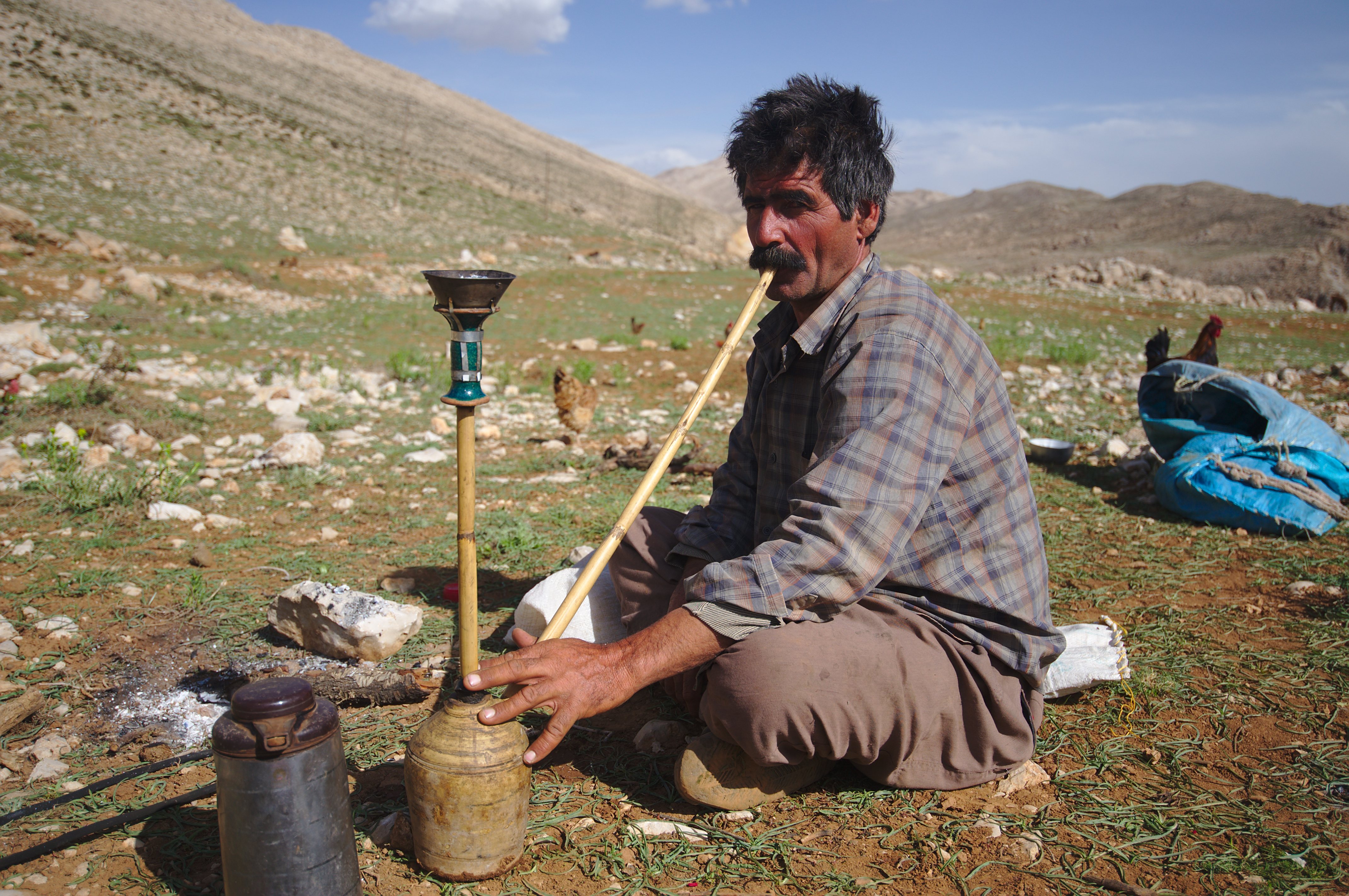
A Qashqai man with a water pipe, Sepidan County, Fars (IAWTIran)
Qashqai nomad children (abbas hosseinimanesh)
Qashqai woman grazing sheep (abbas hosseinimanesh)
Qashqai nomad camp (abbas hosseinimanesh)
Qashqai nomad camp with a solar panel (abbas hosseinimanesh)
A Qashqai nomad woman (ninara, Flickr)

Videos

Sources

  1. Against the Compass: Staying with Qashqai nomads (updated Nov 2025)
  2. gh-ashayer.blogfa.com: Culture of the Qashqai nomads
  3. Global Recordings Network: Qashqa'i
  4. Glottolog: Qashqa'i (qash1240)
  5. Lois Beck, Qashqa'i Nomads and the Islamic Republic (MERIP, 1992)
  6. Qashqai language - Wikipedia
  7. Qashqai people - Wikipedia
  8. Scripture Earth: Qashqa'i (qxq)
  9. Wikimedia Commons: Qashqai nomad photos
  10. ایل قشقایی - Persian Wikipedia