People groups
Yazidi

Yazidi

JPIMBGRN
Countries
13
Language
Northern Kurdish
Religion
Yazidism
Bible status
Complete Bible

Locations

Identity

The Yazidis (Êzidî) are an ethno-religious people of the borderlands of northern Iraq, Syria and Turkiye who speak Kurmanji (Northern Kurdish) and follow Yazidism, an ancient monotheistic faith centred on God's seven holy beings led by Tawûsî Melek, the Peacock Angel, and on the 12th-century Sufi master Sheikh Adi ibn Musafir, whose tomb at Lalish near Mosul is their holiest shrine. Their heartlands are Mount Sinjar (Shingal) on the Syrian border and the Sheikhan district around Lalish, with historic communities in Syria's Jazira and Afrin, Turkiye's Tur Abdin and Batman, and, since flight from the Ottoman Empire in the 19th and early 20th centuries, Armenia and Georgia. Membership comes only by birth to two Yazidi parents, and society is divided into three endogamous castes: sheikhs, pirs and murids (lay followers), the latter organised in tribes such as the Haweri, Mihirkan, Qiran and Hababa. Yazidi oral history counts 74 campaigns of extermination (ferman) against them, from Ottoman expeditions to the Islamic State's genocide of August 2014, in which more than 5,000 were killed and some 6,400 women and children abducted. Whether Yazidis are Kurds is contested: many see themselves as a distinct people, while others call themselves Kurds of the original Kurdish religion. Names include Yezidi, Êzidî and Ezdi; outsiders long and wrongly called them 'devil-worshippers' because of misunderstandings of Tawûsî Melek.

Culture & traditions

Yazidi life revolves around family, caste and village. Marriage must be within the faith and within one's caste, and is arranged between families; leaving the community by marrying out traditionally means exclusion. Sinjar Yazidis were farmers and shepherds growing wheat, barley, figs, olives and tobacco on the mountain's terraces, while Sheikhan villages had olive groves and orchards. Men traditionally wore white, and women white dresses and head-scarves; several colours, especially blue, were avoided, along with certain foods such as lettuce. Religious knowledge is passed on orally through qewl (sacred hymns) sung by qewals with the def and shibab flute, and through stories and lamentations. The great festivals are Çarşema Sor (Red Wednesday, the April New Year), when houses are decorated with red flowers and coloured eggs, the seven-day autumn assembly (Cejna Cemaiya) at Lalish, and the December fast and feast of Ezid. Yazidi music, dance (govend) and wedding customs share much with Kurmanji Kurdish culture.

Religious practices

Yazidis believe in one God who entrusted the world to seven holy beings, chief of them Tawûsî Melek, the Peacock Angel; they reject the idea of a devil. Sheikh Adi and other holy figures are venerated as incarnations of these beings. Every Yazidi has a sheikh and a pir as spiritual guides and a 'brother or sister of the hereafter' (birayê axretê). Practices include praying at sunrise and sunset facing the sun, pilgrimage to Lalish, where pilgrims walk barefoot, tie knots of silk at the shrine of Sheikh Adi and are baptised at the Kaniya Spî (White Spring), baptism of children (mor kirin), and visits to the shrines (mezar) that dot Sinjar and Sheikhan. The community is led by the Mir (Prince), currently Hazim Tahsin Beg, and the spiritual council at Lalish, with the Baba Sheikh as chief religious authority (Ali Ilyas since 2020). After 2014 the spiritual council allowed women freed from Islamic State captivity to return to the faith through a purification at Lalish, an important change; children born of rape remain a painful unresolved question. Displacement, emigration and the secular outlook of diaspora youth are weakening religious knowledge, while the genocide has strengthened communal identity.

Gospel access

Yazidis speak Kurmanji, so they can use the complete Kurmanji Bible in Latin script, the Behdini New Testament and portions in Arabic script, the Jesus Film and Global Recordings Network audio in Kurmanji and Behdini. Because Yazidi identity is inherited and conversion means leaving family and community, very few have become Christians; small groups of Yazidi believers exist in Armenia, Georgia, Germany and the United States, often through Evangelical and Pentecostal churches. In the Kurdistan Region of Iraq, Yazidi leaders have accused Christian aid groups in the camps of proselytising, which makes relief-based witness sensitive. Assyrian and Chaldean Christians in the Nineveh Plains are long-standing neighbours who shared displacement with Yazidis in 2014.

The 2014 Genocide

On 3 August 2014 Islamic State fighters overran Sinjar after Peshmerga forces withdrew. Men and older boys who could not escape were shot in villages such as Kocho, women and girls were taken as slaves and sold across Iraq and Syria, and boys were forced into training as fighters. Tens of thousands fled onto Mount Sinjar without water in the August heat until a corridor opened through Syria with the help of Kurdish fighters and US airstrikes. Estimates put the dead at 5,000-10,000 and the abducted at about 6,400, of whom about 3,500 had been freed by the mid-2020s. The United Nations investigative team (UNITAD), the Iraqi parliament, Germany's Bundestag (2023) and other parliaments recognise the attack as genocide, and the Yazidi Survivors Law of 2021 provides reparations for survivors. Nadia Murad, a survivor from Kocho, received the Nobel Peace Prize in 2018.

At a glance

Language
Northern Kurdish
Language family
Indo-European
Affinity bloc
Central Asian Peoples
People cluster
Kurd
Primary religion
Yazidism
Bible status
Complete Bible
Jesus Film
Yes
Audio recordings
Yes
Gospel recordings
Available
Radio broadcasts
Not Available

Religious breakdown

Religion % DenominationNotes
Yazidism99%Ethnic religion centred on Lalish; endogamous castes of sheikhs, pirs and murids
Christianity<0.5%Evangelical and PentecostalSmall convert groups, mainly in Armenia, Georgia, Germany and the United States; JP gives 0.14% in Iraq

Presence by country

IraqNativeVerified presence
Population
450,000-550,000
Location
Sinjar (Shingal) district and Mount Sinjar, the Sheikhan district around Lalish, Bashiqa and Bahzani, and displacement camps in Duhok and Erbil governorates

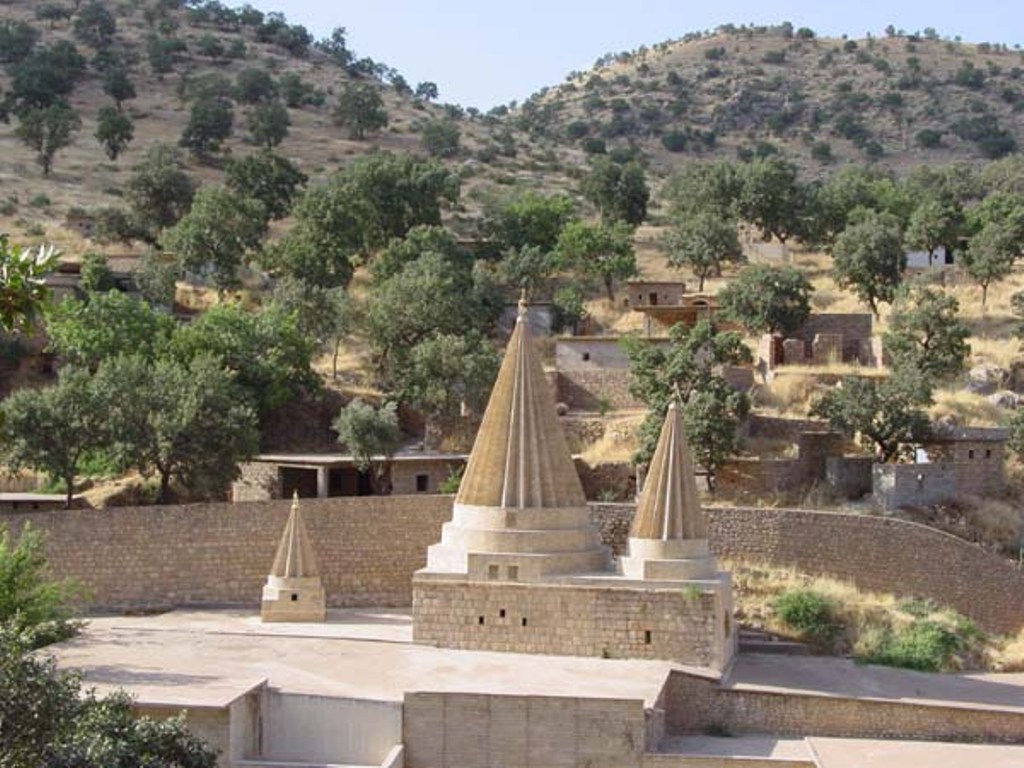
The Yazidis are an ancient Kurmanji-speaking people with a faith of their own, centred on the shrine of Sheikh Adi in the wooded valley of Lalish, where pilgrims walk barefoot and tie knots of silk to make wishes. Their homeland is Mount Sinjar on the Syrian border and the Sheikhan villages north of Mosul, and membership comes only by birth into one of three castes of sheikhs, pirs and lay followers. In August 2014 the Islamic State overran Sinjar, killed thousands of Yazidi men and enslaved thousands of women and children in what Iraq and the United Nations recognise as genocide. More than a decade later, about 2,600 are still missing and tens of thousands of families still live in tents and caravans in camps around Duhok, held back from Sinjar by destroyed homes, rival armed groups and scarce services.

SyriaNativeVerified presence
Population
~10,000-25,000
Location
Hasakah governorate (Qahtaniyah, Amuda, Hasakah, Qamishli, Darbasiyah and Ras al-Ayn villages) and the Kurd Dagh villages of Afrin (Qastal Jindo, Basufan, Faqira, Burj Abdalo, Qibar, Shadeira)

Syria's Yazidis are Kurmanji-speaking followers of an ancient faith centred on Tawûsî Melek, the Peacock Angel, living in two old communities: the olive villages of Kurd Dagh around Afrin and the wheat villages of the Jazira around Qahtaniyah, Amuda and Hasakah. They share the language and much of the village life of their Kurdish Muslim neighbours, but membership comes only by birth within their castes of sheikhs, pirs and murids, and their faith has never been legally recognised. Their numbers have fallen from tens of thousands to perhaps 10,000-25,000 through emigration to Germany and the 2018 flight from Afrin, where more than half of the region's 19 shrines were looted or bulldozed. Since mid-2026 families have been returning to villages such as Qastal Jindo and Faqira, lighting candles and oil lamps in the niches of ruined shrines on Wednesday and Friday nights.

Türkiye (Turkey)NativeVerified presence
Population
~600-2,000
Location
Tur Abdin and Batman villages: Midyat (Güven/Bacin), Nusaybin, Beşiri (Batman), İdil (Mağara/Kiwex, Şırnak), Viranşehir (Burç, Şanlıurfa); Iraqi refugees scattered in cities

The Yazidis of Türkiye are the remnant of an ancient Kurmanji-speaking people who followed their own faith, centred on the Peacock Angel and the shrine of Lalish in Iraq, in the villages of Tur Abdin, Batman and Viranşehir for centuries. Some 60,000 lived here in the 1980s, but massacres in earlier centuries, pressure to convert, land seizures by neighbouring tribes and the Kurdish war of the 1990s drove almost all of them to Germany, so that only a few hundred remain. Since about 2013 some families have come back from Germany, France and Belgium to rebuild their villages, putting up new villas beside the old stone temples of Bacin near Midyat and Kiwex near İdil. Thousands of Iraqi Yazidis fled to Türkiye from the Islamic State's 2014 genocide in Sinjar, but most have since moved on to Europe or returned.

Also found outside the Middle East and North Africa

Armenia, Georgia, Australia, Belgium, Canada, France, Germany, Russia, Sweden, United States

Photos

Yazidi
Yazidi
Entrance to the tomb of Sheikh Adi at Lalish, with the black serpent beside the door
The Lalish valley sanctuary with its fluted conical shrines
Yazidi New Year (Çarşema Sor) at Lalish, April 2017
Yazidi man in Sinjar, July 2019
Yazidi shepherd at a spring on Mount Sinjar
Yazidis of Mount Sinjar, early 20th-century postcard by the Sarrafian brothers
Yazidi fighters inside a Yazidi temple with the image of Tawûsî Melek, northeast Syria

Videos

Sources

  1. A decade after genocide, Yazidi community finds sanctuary in Lincoln — Nebraska Public Media
  2. Anadolu Agency, Ezidis set to return home in southeastern Türkiye (Jan 2023)
  3. Danish Immigration Service: Syria - An update (June 2026), section 10 Situation of Yazidis
  4. Duvar English, Batman's Yazidi families attacked again amid resettlement dispute
  5. Enab Baladi: Yazidis of Afrin: Violations and religious restrictions threaten their existence (Aug 2021)
  6. Habertürk, Yezidiler 50 yıl sonra köylerine döndü (Aug 2025)
  7. IOM-backed return to Sinjar opens for 400+ families — Shafaq News
  8. New Lines: Reviving Yazidi Rituals in the Ruins of Syria's Afrin (26 Aug 2026)
  9. New Yazidi spiritual leader sworn in despite disputes — Rudaw (Nov 2020)
  10. North Press: Yazidis Union in Afrin
  11. Rudaw: Yezidi villages in Syria are being abandoned (2019)
  12. State Department International Religious Freedom Report 2023: Iraq (via country research)
  13. TBMM General Assembly, George Aslan (20 May 2026)
  14. The New Humanitarian: Fear and uncertainty for Yazidis and Kurds in Syria (26 Jan 2026)
  15. UN News Arabic (Aug 2024)
  16. USCIRF 2025 Annual Report: Iraq (via country research)
  17. Wikipedia: Yazidism in Syria
  18. Wikipedia: Yazidism in Turkey
  19. Yazidis make up the majority of IDPs yet to return home — Rudaw (Oct 2025)
  20. Yazidi social organization — Wikipedia
  21. Yazidis say they are being targeted for Christian conversion — VOA
  22. Yazidi Supreme Spiritual Council suspends New Year celebrations — Channel8
  23. Yazidis — Wikipedia
  24. في ذكرى إبادة الإيزيديين — Shafaq News (Arabic)