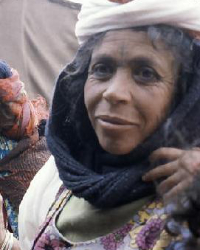
People groups
Bedouin, Nail

Bedouin, Nail

JPIMBGRN
Population in the Middle East and North Africa
42,000
Countries
1
Language
Arabic, Algerian
Religion
Islam - Sunni
Bible status
New Testament

Locations

Identity

The Ouled Nail (أولاد نايل, Oulad Naïl, Awlad Na'il; 'sons of Nail') are an Arab tribal confederation of the Saharan Atlas and the high steppe of central Algeria. They trace their descent to Sidi Nail (Muhammad ibn Abdallah), a 16th-century marabout and sharif who settled in the region; some traditions add a Banu Hilal ancestry. Over the centuries the confederation absorbed Berber and Arab groups and is not homogeneous; its branches descend from Sidi Nail's sons, among them the Ouled Aissa, Ouled Abdallah and Ouled Ahmed. Djelfa and Bou Saâda are its centres, and the range south of Djelfa bears its name. Being Naili is still a matter of pride, and the region is called 'the Ouled Nail region' in Algerian media and festivals. Most people who call themselves Ouled Nail now live in towns and live like other Algerian Arabs; the herding families keep the Bedouin way of life.

Culture & traditions

Herding families lived in black-and-red striped tents and moved between the high steppe and the Saharan pastures; settled kin lived in dechras and ksour. The Naili dance, performed at weddings, has a man question a woman through gestures while she answers with small movements of hands and shoulders, half her face veiled; fighters in the war of independence are said to have used it to pass messages. Women's silver jewellery (khelkhal anklets, fibulae, headdresses with coral), camel-hair burnous from Messaad, rug and tent weaving, falconry and fantasia are regional emblems, and Naili music is the proper name of the genre often called 'Bou Saâda music'.

Religious practices

Maliki Sunni Islam with a strong Sufi layer: the Rahmaniyya and, in the 19th century, the Derqawa order, whose brotherhood set the Ouled Nail apart from the Tijani Larbaa of Laghouat. Zaouias taught religion and letters. Descent from the sharif Sidi Nail gives the confederation religious prestige, and his tomb and other saints' shrines are visited for blessing. Younger townspeople increasingly follow a more scripture-centred Islam learned from preachers on television and online.

Gospel access

The Algerian Arabic New Testament, the Jesus Film and Arabic audio recordings exist. No known believers or outreach; JP lists the Ouled Nail as Frontier (Level 1a) and IMB as unengaged.

Colonial Misrepresentation of Ouled Nail Women

French colonial representations concentrated almost exclusively on Ouled Nail women who temporarily left their highland communities and settled in nearby towns as professional dancers and hostesses. This practice was reframed as prostitution in colonial literature and photography, most infamously in the 1956 Michelin Guide which disparaged the Nailiyat as 'mere courtesans and Oriental dancers.' Contemporary scholarship emphatically rejects this characterization: none of the highland tribes were specialized in prostitution, and women danced because it was part of their culture. The Nailiyat tradition represented a form of female economic autonomy remarkable for its context, with women earning their own fortunes and choosing their own partners.

At a glance

Language
Arabic, Algerian
Language family
Afro-Asiatic
Affinity bloc
Northern African and Middle Eastern Peoples
People cluster
Bedouin, Saharan
Primary religion
Islam - Sunni
Bible status
New Testament
Jesus Film
Yes
Audio recordings
Yes
Gospel recordings
Available
Radio broadcasts
Not Available
Religious school
Maliki

Religious breakdown

Religion % DenominationNotes
Islam~99.9%Sunni (Maliki)
Islam (Sufi)widespread, not measuredRahmaniyya, Derqawa; veneration of Sidi NailIn 1885 the Ouled Nail were Derqawa brothers
Christianity<0.1%No known believers

Presence by country

AlgeriaNativeVerified presence
Population
42,000
Location
Steppe and Ouled Nail Range of Djelfa province (Djelfa, Messaad, Faidh El Botma, Hassi Bahbah, Charef), Bou Saâda (M'Sila); winter pastures towards Ghardaïa

The Ouled Nail are the great Arab tribal confederation of Algeria's high steppe, descendants of the 16th-century holy man Sidi Nail; about 42,000 of them still live as herding families, moving sheep between the alfa-grass plains around Djelfa and Saharan pastures to the south. Djelfa province holds more sheep than any other in Algeria, and herders now move their flocks by truck and buy feed through the dry months. Many more Algerians in Djelfa and Bou Saâda still call themselves Ouled Nail, proud of the Naili dance performed at weddings, the camel-hair burnous of Messaad and the silver jewellery of their women. Their Sunni Islam is coloured by Sufi brotherhoods and by reverence for their founder's lineage.

Photos

Nail Bedouin
Nail Bedouin
Ouled Nail man and woman, Rudolf Lehnert, 1904
Djelfa, 2015
Djelfa, 2015

Sources

  1. A. Geoffroy, Arabes pasteurs nomades de la tribu des Larbas (1885)
  2. Al Jazeera Net, The Algerian Naili: a dance or a soft military operation? (25 March 2022)
  3. Echorouk, Heritage of the Ouled Nail region (1 August 2022)
  4. Feeding strategies of transhumant agropastoralists, Djelfa (Forage Research)
  5. IMB, Bedouin, Nail
  6. Joshua Project, Bedouin, Nail
  7. Material heritage in the land of the Ouled Nail (2025)
  8. Ouled Naïl, Wikipedia
  9. Prince Abdelkader and the Ouled Nail (ASJP, 2025)
  10. Senoussi et al., Revue des BioRessources 15(1), December 2025
  11. The misunderstood nomadic women (Messy Nessy, 2021)
  12. أولاد نايل, Arabic Wikipedia